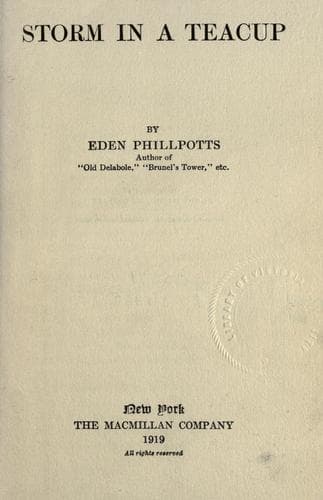
Devon (England) -- Fiction; Husband and wife -- Fiction; Man-woman relationships -- Fiction; Paper mills -- Fiction
“’Tain’t that. It’s selfishness in some cases, and just common sense in
others. We small people are much freer to act than the upper sort. And
as divorce costs a mint of money, there’s thousands and thousands fling
up all hope of an orderly release, and part, and go their own way, and
live respectable lives that make the Church properly yelp and wring its
hands. But the Church is powerless against the Law, so my husband says;
and the Law takes very good care to keep the whip-hand and make divorce
a great source of income for lawyers. However, Dingle is a prosperous
man, and no doubt he’ll run to it and do the needful. The trouble in
these cases is the children, and lucky that don’t arise this time. ’Tis
a very great thing in my view that a woman should have her children by
the man she prefers.”
“Who wants children?” asked Medora. “They’re nothing but a curse and a
nuisance most times. Me and Mr. Kellock want to do important things in
the world, Mrs. Hayman.”
“If you can think of anything more important than getting a brace of
good healthy children, I’d be glad to know what it is,” answered the
landlady. “I speak without prejudice in that matter, never having
had none myself. But that’s no fault of ours—merely the will of
Providence, and nothing more puzzling or outrageous ever happened, for
I was one of seven and Abel one of ten; and yet God willed me barren—a
good mother blasted in the bud, you might say. I sometimes wish the
Almighty would let Nature take its course a bit oftener.”
Medora was glad that Kellock arrived at this moment.
“I’m going to have a glass of beer, Jordan,” she said. “I’m properly
tired to-night, and I shan’t sleep if I don’t.”
He answered nothing, for she had promised to give up stimulant. Then
Mrs. Hayman went to fetch their supper.
Medora enjoyed familiar Devon food, ate well, and slept well enough
presently in a comfortable feather bed, with the murmur of Bow River
for a lullaby.
The next day was Sunday, and Mrs. Trivett duly arrived, to be received
in the little parlour. Medora kissed her, and Kellock offered to shake
hands; but he found that Lydia was far from cordial. She kissed Medora
coldly, and ignored the man.
“I felt it my duty to see you, Medora,” she began, “because I don’t
want for you, nor yet Mr. Kellock, to be under any doubt about my
feelings. I think you’ve done a very evil and ill-convenient thing,
and I’d like to know what would become of the world if everybody was
to break their oaths and make hay of their marriage lines, same as you
have.”
Medora quoted from Mrs. Hayman, and Kellock ventured to think that each
case ought to be judged on its own merits.
Public-domain text, read in full here on John Shaqi.
Reviews
Reviews
No reviews yet
Be the first to share your thoughts on this work.
Elsewhere in the archive
Join the Discussion
Join the discussion
Sign in to leave a comment or review.
Sign InorCreate an account