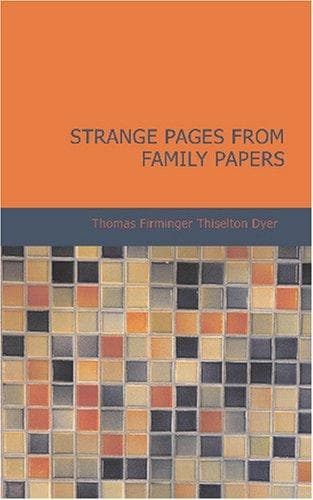
Strange Pages from Family PapersThiselton-Dyer, T. F. (Thomas Firminger)
History
Strange Pages from Family Papers
Thiselton-Dyer, T. F. (Thomas Firminger)
Legends; Superstition
party were thrown into much consternation by the non-arrival of the
bridegroom. Everything was in readiness, the clergy and the choir,
already vested, stood in the robing room, crimson carpets were laid
down from the door to the carriages; some of the guests were at the
church and others at the bride's house, when an alarm was raised by
the best man that the bridegroom could nowhere be found. The
bride-expectant burst into a flood of tears at this cruel
disappointment, especially when the ominous news reached the church
that the bridegroom's wedding suit had been found in the room, laid
out ready to wear, but that there was not the slightest clue as to his
whereabouts. It only remained for the bridal party to return home, and
for the dejected and disconsolate bride to lay aside her veil and
orange-blossoms.
Sometimes, on the other hand, it is the bride who disappears at this
crisis. Not many years back, an ex-lieutenant in the Royal Navy
applied to a London magistrate, as he wanted to find his newly married
wife. The applicant affirmed that the lady he had wedded was an
actress, and that they were married at the registry office at Croydon.
The magistrate asked if there had been any wedding breakfast. The
applicant said "No"; they had partaken of a little luncheon and that
was all. Mysterious and inexplicable as was this disappearance of a
wife so shortly after marriage, it was suggested by the magistrate
whether there were any rivals, but the applicant promptly replied,
"No, certainly not, and that made the matter all the more
incomprehensible." Of course, the magistrate could not recover the
missing bride; but, remarking that the application was a very singular
one, he recommended the applicant to consult the police on the matter,
who replied that "he would do so, as he was really afraid that some
mischief had happened to her," utterly disregarding the proposition of
the magistrate as to whether the lady could not possibly have changed
her mind, remarking that such a thing had occasionally happened.
In the life of Dr. Raffles, an amusing story is quoted, which is
somewhat to the point: "On our way from Wem to Hawkstone, we passed a
house, of which the following occurrence was told: 'A young lady, the
daughter of the owner of the house, was addressed by a man who, though
agreeable to her, was disliked by her father. Of course, he would not
consent to their union, and she determined to disappear and elope. The
night was fixed, the hour came, he placed the ladder to the window,
and in a few minutes she was in his arms. They mounted a double horse,
and were soon at some distance from the house. After awhile the lady
broke silence by saying, 'Well, you see what a proof I have given you
of my affection; I hope you will make me a good husband!'
"He was a surly fellow, and gruffly answered, 'Perhaps I may, and
perhaps not.'
Public-domain text, read in full here on John Shaqi.
Reviews
Reviews
No reviews yet
Be the first to share your thoughts on this work.
Elsewhere in the archive
Join the Discussion
Join the discussion
Sign in to leave a comment or review.
Sign InorCreate an account