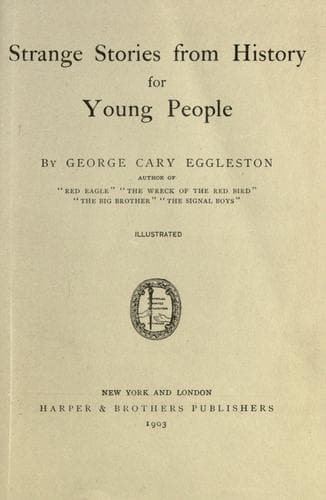
Strange Stories from History for Young PeopleEggleston, George Cary
History
Strange Stories from History for Young People
Eggleston, George Cary
World history -- Juvenile literature
There are not many boys in our time who have not declaimed parts of
Webster's great speeches; and it will interest them to know that the boy
who afterwards made those speeches could never declaim at all while he
was at school. He learned his pieces well, and practised them in his own
room, but he could not speak them before people to save his life.
Webster was always fond of shooting and fishing, and, however hard he
studied, the people around him called him lazy and idle, because he
would spend whole days in these sports. Once, while he was studying
under Dr. Woods to prepare for college, that gentleman spoke to him on
the subject, and hurt his feelings a little. The boy went to his room
determined to have revenge, and this is the way he took to get it. The
usual Latin lesson was one hundred lines of Virgil, but Webster spent
the whole night over the book. The next morning before breakfast he went
to Dr. Woods and read the whole lesson correctly. Then he said:
"Will you hear a few more lines, doctor?"
The teacher consenting, Webster read on and on and on, while the
breakfast grew cold. Still there was no sign of the boy's stopping, and
the hungry doctor at last asked how much farther he was prepared to
read.
"To the end of the twelfth book of the AEneid," answered the "idle" boy,
in triumph.
After that, Webster did not give up his hunting and fishing, but he
worked so hard at his lessons, and got on so fast, that there was no
further complaint of his "idleness." He not only learned the lessons
given to him, but more, every day, and besides this he read every good
book he could lay his hands on, for he was not at all satisfied to know
only what could be found in the school-books.
Webster's father was poor and in debt, but finding how eager his boy was
for education, and seeing, too, that he possessed unusual ability, he
determined, ill as he could afford the expense, to send him to college.
Accordingly, young Daniel went to Dartmouth.
Many anecdotes are told to illustrate the character of young Dan. He was
always lavish of his money when he had any, while his brother was
careful but generous, especially to Dan, whom he greatly admired. On one
occasion the boys went to a neighboring town on a high holiday, each
with a quarter of a dollar in his pocket.
"Well, Dan," said the father on their return, "what did you do with your
money?"
"Spent it," answered the boy.
"And what did you do with yours, Zeke?"
"Lent it to Dan," was the answer. The fact was that Dan had spent both
quarters.
Public-domain text, read in full here on John Shaqi.
Reviews
Reviews
No reviews yet
Be the first to share your thoughts on this work.
Elsewhere in the archive
Join the Discussion
Join the discussion
Sign in to leave a comment or review.
Sign InorCreate an account