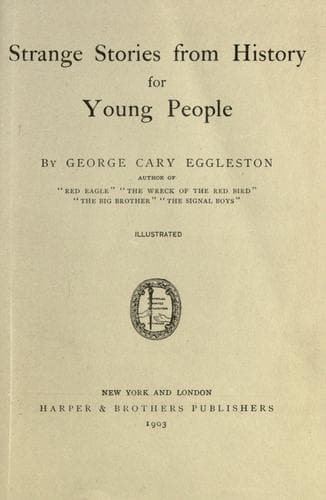
Strange Stories from History for Young PeopleEggleston, George Cary
History
Strange Stories from History for Young People
Eggleston, George Cary
World history -- Juvenile literature
Young Webster was very industrious in his studies, as we have seen, and
he was physically strong and active as his fondness for sport proved;
but he could never endure farm-work. One day his father wanted him to
help him in cutting hay with a scythe; but very soon the boy complained
that the scythe was not "hung" to suit him; that is to say, it was not
set at a proper angle upon its handle. The old gentleman, adjusted it,
but still it did not suit the boy. After repeated attempts to arrange it
to Dan's liking, the father said, impatiently, "Well, hang it to suit
yourself." And young Dan immediately "hung" it over a branch of an
apple-tree and left it there. That was the hanging which pleased him.
[Illustration: "'TO THE END OF THE TWELFTH BOOK OF THE AENEID,' ANSWERED
THE 'IDLE' BOY, IN TRIUMPH."]
After finishing his college course Webster began studying law, but
having no money, and being unwilling to tax his father for further
support, he went into Northern Maine, and taught school there for a
time. While teaching he devoted his evenings to the work of copying
deeds and other legal documents, and by close economy managed to live
upon the money thus earned, thus saving the whole of his salary as a
teacher. With this money to live on, he went to Boston, studied law, and
soon distinguished himself. The story of his life as a public man, in
the senate, in the cabinet, and at the bar, is well known, and does not
belong to this sketch of his boyhood.
THE SCULLION WHO BECAME A SCULPTOR.
In the little Italian village of Possagno there lived a jolly
stone-cutter named Pisano. He was poor, of course, or he would not have
been a stone-cutter; but he was full of good humor, and everybody liked
him.
There was one little boy, especially, who loved old Pisano, and whom old
Pisano loved more than anybody else in the world. This was Antonio
Canova, Pisano's grandson, who had come to live with him, because his
father was dead, and his mother had married a harsh man, who treated the
little Antonio roughly.
Antonio was a frail little fellow, and his grandfather liked to have him
near him during his working hours.
While Pisano worked at stone-cutting, little Canova played at it and at
other things, such as modelling in clay, drawing, etc. The old
grandfather, plain, uneducated man as he was, soon discovered that the
pale-faced little fellow at his side had something more than an ordinary
child's dexterity at such things.
The boy knew nothing of art or of its laws, but he fashioned his lumps
of clay into forms of real beauty. His wise grandfather, seeing what
this indicated, hired a teacher to give him some simple lessons in
drawing, so that he might improve himself if he really had the artistic
ability which the old man suspected. Pisano was much too poor, as he
knew, ever to give the boy an art-education and make an artist of him,
but he thought that Antonio might at least learn to be a better
stone-cutter than common.
Public-domain text, read in full here on John Shaqi.
Reviews
Reviews
No reviews yet
Be the first to share your thoughts on this work.
Elsewhere in the archive
Join the Discussion
Join the discussion
Sign in to leave a comment or review.
Sign InorCreate an account