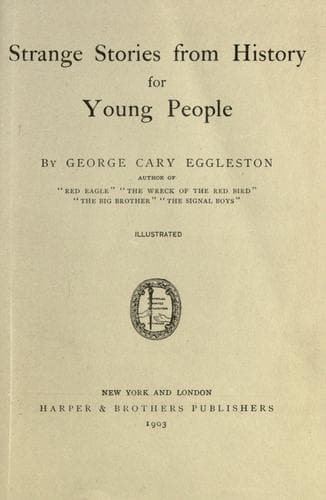
Strange Stories from History for Young PeopleEggleston, George Cary
History
Strange Stories from History for Young People
Eggleston, George Cary
World history -- Juvenile literature
They scanned the butter lion critically, and then broke forth in a
torrent of praises, insisting that Faliero should tell them at once
what great sculptor he had persuaded to waste his skill upon a work in
butter, that must quickly melt away. But Signor Faliero was as ignorant
as they, and he had, in his turn, to make inquiry of the chief servant.
When the company learned that the lion was the work of a scullion,
Faliero summoned the boy, and the banquet became a sort of celebration
in his honor.
But it was not enough to praise a lad so gifted. These were men who knew
that such genius as his belonged to the world, not to a village, and it
was their pleasure to bring it to perfection by educating the boy in
art. Signor Faliero himself claimed the right to provide for young
Antonio, and at once declared his purpose to defray the lad's expenses,
and to place him under the tuition of the best masters.
The boy whose highest ambition had been to become a village
stone-cutter, and whose home had been in his poor old grandfather's
cottage, became at once a member of Signor Faliero's family, living in
his palace, having everything that money could buy at his command, and
daily receiving instruction from the best sculptors of Venice.
But he was not in the least spoiled by this change in his fortunes. He
remained simple, earnest, and unaffected. He worked as hard to acquire
knowledge and skill in art as he had meant to work to become a dexterous
stone-cutter.
Antonio Canova's career from the day on which he moulded the butter into
a lion was steadily upward; and when he died, in 1822, he was not only
one of the most celebrated sculptors of his time, but one of the
greatest, indeed, of all time.
THE BOYHOOD OF WILLIAM CHAMBERS.
Boys and girls who can buy attractive periodicals and books at any
bookstore or news-stand, can have very little notion of the difficulty
that little folk had seventy or eighty years ago in getting something to
read. It was only about fifty years ago, indeed, that this first efforts
were made to supply cheap, instructive, and entertaining literature, and
one of the men who made those efforts was Mr. William Chambers, who, in
1882, when he was eighty-two years of age, published a little account of
his life. What he has to tell of his boyhood and youth is very
interesting.
Public-domain text, read in full here on John Shaqi.
Reviews
Reviews
No reviews yet
Be the first to share your thoughts on this work.
Elsewhere in the archive
Join the Discussion
Join the discussion
Sign in to leave a comment or review.
Sign InorCreate an account