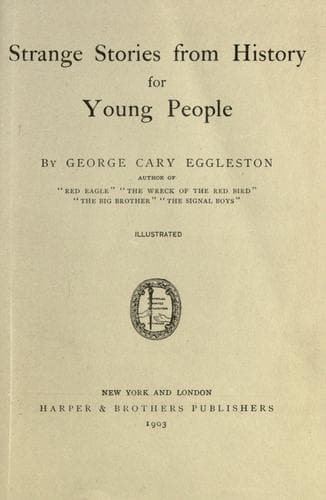
Strange Stories from History for Young PeopleEggleston, George Cary
History
Strange Stories from History for Young People
Eggleston, George Cary
World history -- Juvenile literature
As the boy grew older he began to help in the shop during the day, while
in the evening his grandmother told him stories or sang or recited
poetry to him. All these things were educating him, though without his
knowing it, for they were awakening his taste and stimulating his
imagination, which found expression in the clay models that he loved to
make in his leisure hours.
It so happened that Signor Faliero, the head of a noble Venetian family,
and a man of rare understanding in art, had a place near Pisano's house,
and at certain seasons the nobleman entertained many distinguished
guests there. When the palace was very full of visitors, old Pisano was
sometimes hired to help the servants with their tasks, and the boy
Canova, when he was twelve years old, sometimes did scullion's work
there, also, for a day, when some great feast was given.
On one of these occasions, when the Signor Faliero was to entertain a
very large company at dinner, young Canova was at work over the pots and
pans in the kitchen. The head-servant made his appearance, just before
the dinner hour, in great distress.
The man who had been engaged to furnish the great central ornament for
the table had, at the last moment, sent word that he had spoiled the
piece. It was now too late to secure another, and there was nothing to
take its place. The great vacant space in the centre of the table
spoiled the effect of all that had been done to make the feast artistic
in appearance, and it was certain that Signor Faliero would be sorely
displeased.
But what was to be done? The poor fellow whose business it was to
arrange the table was at his wits' end.
While every one stood dismayed and wondering, the begrimed scullion boy
timidly approached the distressed head-servant, and said, "If you will
let me try, I think I can make something that will do."
"You!" exclaimed the servant; "and who are you?"
"I am Antonio Canova, Pisano's grandson," answered the pale-faced little
fellow.
"And what can you do, pray?" asked the man, in astonishment at the
conceit of the lad.
"I can make you something that will do for the middle of the table,"
said the boy, "if you'll let me try."
The servant had little faith in the boy's ability, but not knowing what
else to do, he at last consented that Canova should try.
Calling for a large quantity of butter, little Antonio quickly modelled
a great crouching lion, which everybody in the kitchen pronounced
beautiful, and which the now rejoicing head-servant placed carefully
upon the table.
The company that day consisted of the most cultivated men of
Venice--merchants, princes, noblemen, artists, and lovers of art--and
among them were many who, like Faliero himself, were skilled critics of
artwork.
When these people were ushered in to dinner their eyes fell upon the
butter lion, and they forgot for what purpose they had entered the
dining-room. They saw there something of higher worth in their eyes than
any dinner could be, namely, a work of genius.
Public-domain text, read in full here on John Shaqi.
Reviews
Reviews
No reviews yet
Be the first to share your thoughts on this work.
Elsewhere in the archive
Join the Discussion
Join the discussion
Sign in to leave a comment or review.
Sign InorCreate an account