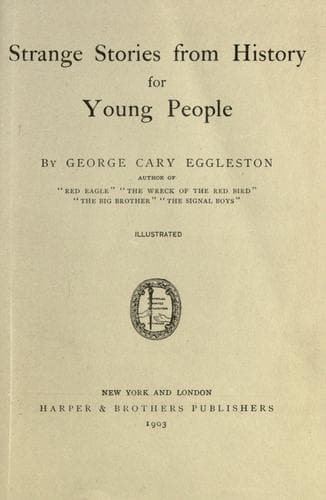
Strange Stories from History for Young PeopleEggleston, George Cary
History
Strange Stories from History for Young People
Eggleston, George Cary
World history -- Juvenile literature
He accepted the proposition at once, and for two and a half hours every
morning he sat on a flour-sack in the cellar, and read to the bakers by
the light of a penny candle stuck in a bottle.
Out of his small wages it was impossible for the boy to save anything,
and so, when the five years of his apprenticeship ended, he had only
five shillings in the world. Yet he determined to begin business at once
on his own account. Getting credit for ten pounds' worth of books, he
opened a little stall, and thus began what has since grown to be a great
publishing business.
He had a good deal of unoccupied time at his stall, and "in order to
pick up a few shillings," as he says, he began to write out neat copies
of poems for albums. Finding sale for these, he determined to enlarge
that part of his business by printing the poems. For that purpose he
bought a small and very "squeaky" press and a font of worn type which
had been used for twenty years. He had to teach himself how to set the
type, and, as his press would print only half a sheet at a time, it was
very slow work; but he persevered, and gradually built up a little
printing business in connection with his book-selling. After a while he
published an edition of Burns's poems, setting the type, printing the
pages, and binding the books with his own hands, and clearing eight
pounds by the work.
Chambers wrote a good deal at that time, and his brother Robert wrote
still more, so that they were at once authors, printers, publishers, and
booksellers, but all in a very small way. After ten years of this work,
William Chambers determined to publish a cheap weekly paper, to be
filled with entertaining and instructive matters, designed especially
for the people who could not afford to buy expensive books and
periodicals. Robert refused to join in this scheme, and so, for a time,
the whole work and risk fell upon William. His friends all agreed in
thinking that ruin would be the result; but William Chambers thought he
knew what the people wanted, and hence he went on.
The result soon justified his expectations. The first number was
published on the 4th of February, 1832. Thirty thousand copies were sold
in a few days, and three weeks later the sale rose to fifty thousand
copies a week.
HOW A BOY WAS HIRED OUT, AND WHAT CAME OF IT.
When Michael Angelo was twelve years of age, although he had had no
instruction in art, he did a piece of work which greatly pleased the
painter Domenico Ghirlandajo. That artist at once declared that here was
lad of genius, who must quit his school studies and become a painter.
This was what the little Michael most wished to do, but he had no hope
that his father would listen for a moment to the suggestion. His father,
Ludovico Buonarotti, was a distinguished man in the state, and held art
and artists in contempt. He had planned a great political career for his
boy, as the boy knew very well.
Public-domain text, read in full here on John Shaqi.
Reviews
Reviews
No reviews yet
Be the first to share your thoughts on this work.
Elsewhere in the archive
Join the Discussion
Join the discussion
Sign in to leave a comment or review.
Sign InorCreate an account