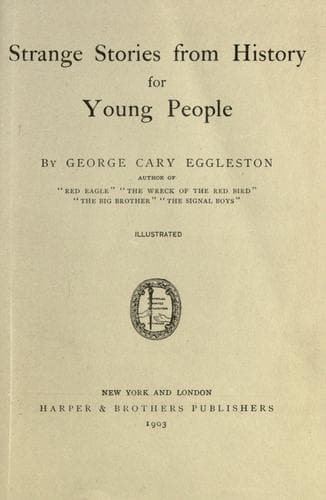
Strange Stories from History for Young PeopleEggleston, George Cary
History
Strange Stories from History for Young People
Eggleston, George Cary
World history -- Juvenile literature
Dmitri was now out of the way, or, rather, he would have been if he had
had an ordinary capacity for staying comfortably killed; and Boris
redoubled his efforts to prepare the way for his own elevation to the
throne, as Feodor's successor, when that prince should chance to let the
sceptre fall from his grasp.
To secure the influence of the Church in his behalf, he bought of a
Greek bishop the right to appoint the successor of the patriarch (a sort
of Greek Church pope); and that office presently becoming vacant, he
appointed a creature of his own as head of the Church. He succeeded in
winning the favor of the inferior nobility, who were very numerous, and
made himself strong in many other ways.
Boris was a fellow of infinite good-luck; and so it fell out that, at
the precise moment when all his plans were complete, the Czar Feodor
obligingly died. So opportunely did this event happen, that grave
historians have been inclined to suspect Boris of having procured it in
some way; but of this there is no positive evidence.
Feodor dead, there was no heir to the throne. With him ended the line of
Rurik, which alone the Russians recognized as legitimately entitled to
rule the empire; and now a new czar must be chosen. The nobles
quarrelled, of course. They agreed in thinking that one of their order
should be elevated to the throne; but they could by no means agree which
one it should be. Each resented the pretensions of all the others, and
it speedily became manifest that the patriarch's nomination, upon
whomsoever it might fall, would turn the scale and elect a czar. The
patriarch was Boris's own creature, appointed for the sole purpose of
forwarding that minister's plans; and he promptly nominated Boris to the
vacant throne. The election was a prearranged affair; and presently
Boris was waited upon--in the convent to which he had retired with the
declared purpose of leading a monastic life in future--and informed of
his selection by the people as Czar of all the Russias. He modestly
declined, of course; and, equally of course, his modesty only made the
people the more clamorous. After some weeks of petty dalliance Boris
finally allowed himself to be persuaded, and was crowned czar, in due
form, in the year 1598.
He was not long in discovering that his position was insecure, and
incapable of being made safe. Whatever policy he might adopt--and he was
disposed, it appears, to govern wisely and well--was sure to displease
some of his subjects; and in the hands of a hostile faction, his want of
hereditary claim upon the throne was a powerful weapon. What he had
seized by crime he must keep by tyranny and violence, and a three years'
famine added greatly to his embarrassments. Whatever he did excited
discontent; and to make his wretchedness complete, he fancied himself
haunted by the ghost of the murdered Dmitri. There were symptoms of
mutiny everywhere, which daily threatened to culminate in open revolt.
It needed only a match to fire the mine.
Public-domain text, read in full here on John Shaqi.
Reviews
Reviews
No reviews yet
Be the first to share your thoughts on this work.
Elsewhere in the archive
Join the Discussion
Join the discussion
Sign in to leave a comment or review.
Sign InorCreate an account