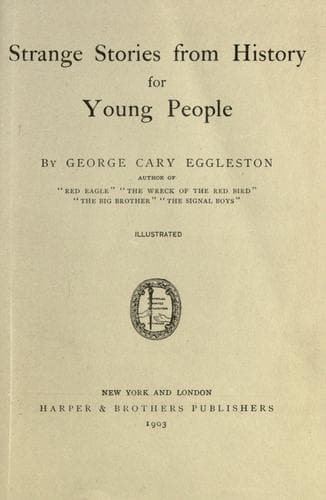
Strange Stories from History for Young PeopleEggleston, George Cary
History
Strange Stories from History for Young People
Eggleston, George Cary
World history -- Juvenile literature
He was able, without much difficulty, to interest the King of Poland in
his behalf, and to secure a declaration of war by that potentate against
Czar Schnisky. He invaded Russia, won battles, captured Smolensko,
invested Moscow, and finally entered the city.
About this time Dmitri appeared in several other places, but only one of
him was in Moscow at the head of a victorious army; and in behalf of
this particular one Schnisky resigned his crown and retired to a
monastery, whence he was soon removed to a dungeon.
At this juncture the King of Poland, having plans of his own for the
union of Russia and his own kingdom, withdrew his countenance from
Dmitri; and that prince retired from the business of governing, and
devoted himself for the rest of his life to the less honorable, but
perhaps equally lucrative, profession of highway robbery. He was again
killed after awhile, this time by a Don Cossack. But even this public
killing had small effect. A dozen or more new Dmitri's appeared,
claiming the throne; and some of them, says the historian Bell,
"actually touched the sceptre for a moment, but only to recoil in fear
from the dangerous object of their insane ambition."
After awhile, having found the task an unprofitable one, perhaps, Dmitri
seems to have made up his mind to stay dead; but in due course a race of
his sons sprang up quite as mysteriously, if not quite as persistently,
to pester the Russians, and peace came to them only through the
elevation of the Romanoffs to the imperial throne. Connected as they
were by ties of blood with the race of Rurik, they brought legitimacy to
the rescue of a land long torn by faction. The loyalty of the people to
sovereigns whose right to rule was derived from Rurik, gave the dynasty
a strength sufficient to maintain itself; and after a little while Peter
the Great taught his Russians civilization, and a new era in Russian
history was begun.
Public-domain text, read in full here on John Shaqi.
Reviews
Reviews
No reviews yet
Be the first to share your thoughts on this work.
Elsewhere in the archive
Join the Discussion
Join the discussion
Sign in to leave a comment or review.
Sign InorCreate an account