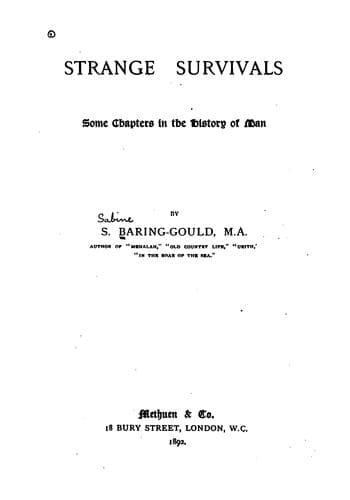
Strange Survivals: Some Chapters in the History of ManBaring-Gould, S. (Sabine)
History
Strange Survivals: Some Chapters in the History of Man
Baring-Gould, S. (Sabine)
Manners and customs -- Origin; Superstition
“There was three ladies in a ha’,
Fine flowers i’ the valley;
There came three lords among them a’,
Hi’ the red, green, and the yellow.”
Now, the remarkable thing is, that there is still sung in Cornwall--or
was, till quite recently--a form of the ballad with a burden like this
latter. It begins--
“There was a woman and she was a widow,
O the red, the green, and the yellow!
And daughters had three as the elm tree,
The flowers they blow in the valley.”
with this chorus:--
“The harp, the lute, the fife, the flute, and the cymbal.
Sweet goes the treble violin,
The flowers that blow in the valley.”
How is it possible that a ballad sung in two forms in Scotland, and
recovered there in a fragmentary condition, should be known in very
similar forms in Cornwall? To suppose that the two versions were
carried from the Highlands to the Land’s End, so as to have become
popular, is inconceivable. It is more likely that the same English
ballad found its way both north and south-west, and when it had been
displaced elsewhere, remained in the extremities of the island. The
burden in each case is clearly that which marked the melody. We very
much wish that the Scottish airs, to which these ballads were sung, had
been preserved, that they might be compared with those to which they
were sung in Cornwall. The burden in each case has nothing to do with
the story, but it seems to indicate that the same ballad in its two
forms, to two independent airs, was carried all over Great Britain at
some period unknown. The same ballad was also sung in Cheshire at the
close of last century, and also in Ireland.
Another specimen given by Mr. Gilbert is that of the “Three Sisters.”
“There were three sisters fair and bright,
Jennifer, Gentle and Rosemaree;
And they three loved one valiant knight;
As the doo (dove) flies over the mulberry tree.”[36]
The same is found in broadside, in the Pepysian and other collections,
and as “The Unco Knicht’s Wooing” in Scotland.
Take again the ballad of “The Elfin Knight” or “The Wind hath blown
my Plaid away.” This is found in Scotland, but also as a broadside in
the Pepysian collection; it was the subject within the memory of man
of a sort of play in farmhouses in Cornwall; it is found in a more or
less fragmentary condition all over England. The same ballad is found
in German, in Danish, in Wend--and the story in Tyrol, in Siberia, and
Thibet.
Public-domain text, read in full here on John Shaqi.
Reviews
Reviews
No reviews yet
Be the first to share your thoughts on this work.
Elsewhere in the archive
Join the Discussion
Join the discussion
Sign in to leave a comment or review.
Sign InorCreate an account