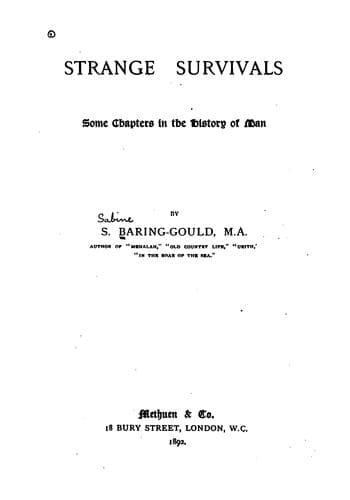
Strange Survivals: Some Chapters in the History of ManBaring-Gould, S. (Sabine)
History
Strange Survivals: Some Chapters in the History of Man
Baring-Gould, S. (Sabine)
Manners and customs -- Origin; Superstition
“Bad news! bad news through London street,
Bad news has come to the King,
For all the brave lives of his mariners lost,
That sunk in the watery main.”
Now there is sad confusion here. The ballad as it now exists is a mere
fragment. Clearly the “bad news” belongs to an earlier portion of the
ballad, and it induces the King to send against the pirate and to sink
his vessel. This “Henry Martyn” is, in fact, Andrew Barton. In 1476,
a Portuguese squadron seized a richly laden vessel, commanded by John
Barton, in consequence of which letters of reprisal were granted to
Andrew, Robert, and John Barton, sons of John, and these were renewed
in 1506. The King of Portugal remonstrated against reprisals for so
old an offence, but he had put himself in the wrong four years before,
by refusing to deal with a herald sent by the Scottish King for the
arrangement of the matter in dispute. Hall, in his Chronicle, says: “In
June, 1511, the King (Henry VIII.) being at Leicester, tidings were
brought him that Andrew Barton, a Scottish man, and a pirate of the
sea, did rob every nation, and so stopped the King’s streams that no
merchants almost could pass, and when he took the Englishmen’s goods,
he said they were Portingale’s goods, and thus he haunted and robbed at
every haven’s mouth. The King, moved greatly with this crafty pirate,
sent Sir Edward Howard, Lord Admiral of England, and Lord Thomas
Howard, son and heir to the Earl of Surrey, in all haste to the sea,
which hastily made ready two ships, and without any more abode, took
the sea, and by chance of weather, were severed. The Lord Howard lying
in the Downs, perceived when Andrew blew his whistle to encourage the
men, yet, for all that, the Lord Howard and his men, by clean strength,
entered the main deck; then the Englishmen entered on all sides, and
the Scots fought sore on the hatches, but, in conclusion, Andrew was
taken, which was so sore wounded that he died there; then all the
remainder of the Scots were taken with their ship, called the _Lion_.”
Buchanan, about twenty years after Hall--_i.e._, in 1582--also tells
the story. Barton he calls Breton with further details. He says that
Andrew Breton, though several times wounded, and with one leg broken by
a cannon ball, seized a drum and beat a charge to inspirit his men to
fight, until breath and life failed.
Now a ballad relative to Sir Andrew Barton has been given by Percy; it
is found among the Douce, the Pepysian, the Roxburghe, the Bagford, and
the Wood collection of old English ballads. In the Percy MS. the ballad
consists of eighty-two stanzas, but there is something lost between the
thirty-fifth and the next. It begins:--
“As itt beffell in Midsummer-time
When birds sing sweetlye on every tree,
Our noble king, King Henry the Eighth,
Over the river Thames past he.”
Another version is in the black letter collection. It begins:--
Public-domain text, read in full here on John Shaqi.
Reviews
Reviews
No reviews yet
Be the first to share your thoughts on this work.
Elsewhere in the archive
Join the Discussion
Join the discussion
Sign in to leave a comment or review.
Sign InorCreate an account