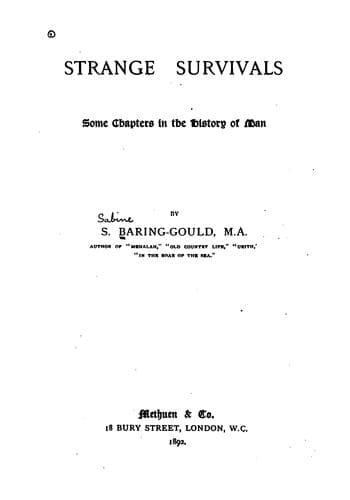
Strange Survivals: Some Chapters in the History of ManBaring-Gould, S. (Sabine)
History
Strange Survivals: Some Chapters in the History of Man
Baring-Gould, S. (Sabine)
Manners and customs -- Origin; Superstition
In the reign of Queen Anne and through the early Hanoverian period,
sheets of copperplate were issued with engraved songs and ballads,
together with their music. Among them may be found a few--but only
a very few--of the old favourites. Most are compositions of Arne,
Carey, Berg, Dunn, etc., and the words are quite unsuited to hold the
attention of the peasantry. Hardly any of these found their way into
broadsides and garlands, and none can now be heard by the cottage fire
or in the village ale-house.
In 1808, John Catnach of Newcastle settled in London, and began to
print broadsides. He was quickly followed by others in London and in
country towns. Catnach kept a number of ballad-mongers in his pay, who
either composed verses for him or swept up such traditional ballads as
they chanced to hear. They were paid half-a-crown for a copy, whether
original or adulterate. If one of these poetasters chanced to hear an
ancient ballad, he added to it some of his own verses, so as to be
able to call it his property, and then disposed of it to one of the
broadside publishers.
If these men had been sent round the country to collect from cottages
and village hostelries, in the way in which Wardour Street Jews send
about into every part of England to pick up old oak, then a great
amount of our traditional ballad poetry might have been recovered. It
was not too late in the first ten or twenty years of this century.
But this was not done. These pot-poets loafed about in the low London
public-houses, where it was only by the rarest chance that a country
man, fresh from the fields, and woods, and downs, with his memory laden
with the fragrance of the rustic music, was to be found. Moreover,
these fellows were overweening in their opinion of their own powers.
They had neither taste, nor ear, nor genius. They poured forth floods
of atrocious rhymes, and of utter balderdash, as was required, as
an occasion offered, and as they stood in need of half-crowns.
Consequently the broadside “white-letter” ballad no more represents the
folk ballad of the English people than does the black-letter ballad.
Who that has a sprinkling of grey on his head does not remember the
ballad-singer at a fair, with his or her yards of verse for sale? The
ballad-seller, who vended his broadsheets, did much to corrupt the
taste of the peasant. He had begun to read, and he read the ha’penny
broadside, and learned by heart what he had bought; then he set it to
some fine old melody as ancient as the Wars of the Roses, and sang it;
and what is unfortunate, discarded the old words for the sake of the
vile stuff composed by the half-tipsy, wholly-stupid band, in the pay
of Ryle, Catnach, Harkness of Preston, Williams of Portsea, Snidall of
Manchester, etc.
Public-domain text, read in full here on John Shaqi.
Reviews
Reviews
No reviews yet
Be the first to share your thoughts on this work.
Elsewhere in the archive
Join the Discussion
Join the discussion
Sign in to leave a comment or review.
Sign InorCreate an account