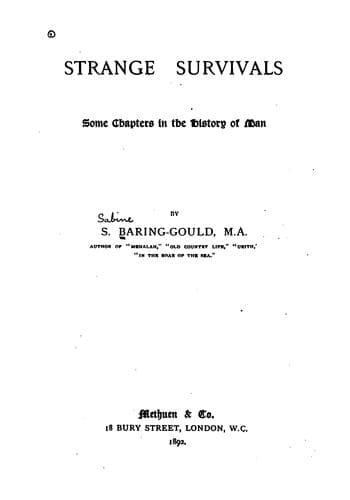
Strange Survivals: Some Chapters in the History of ManBaring-Gould, S. (Sabine)
History
Strange Survivals: Some Chapters in the History of Man
Baring-Gould, S. (Sabine)
Manners and customs -- Origin; Superstition
“A boy we wanted--’tis a girl!
Thus all our hopes that were
To have an heir unto the Throne
Are all _thrown to the air_.”
Here is a ballad on a policeman of the old style when the new
regulations came in, in 1829:--
“Upon his beat he stood to take a last farewell
Of his lantern and his little box wherein he oft did dwell.
He listen’d to the clock, so familiar to his ear,
And with the tail of his drab coat he wiped away a tear.
“Beside that watchhouse door a girl was standing close,
Who held a pocket handkerchief, with which she blew her nose.
She rated well the policeman, which made poor Charley queer,
Who once more took his old drab coat to wipe away a tear.
“He turn’d and left the spot; O do not deem him weak;
A sly old chap this Charley was, though tears were on his cheek.
Go watch the lads in Fetterlane, where oft you’ve made them fear;
The hand, you know, that takes a bribe, can wipe away a tear.”
Here is one stanza by a composer with whom the writer of this article
made acquaintance:--
“Pale was the light of the Pole-axe star,
When breakers would hide them so near.
But Love is the ocean of hunters far,
And convoys him to darkness so drear.
Then sad at the door of my love I lay,
Slumbering the six months all away.”
Horace sang something about lying exposed to the cold and rain at the
door of his beloved, and vowed he would not do it again. There is
certainly a distance of something beside two thousand years between
Horace and the gentleman who wrote the above lines.
There is a really astonishing poem entitled “The Lights of Asheaton,”
which, happily, everyone can purchase for a ha’penny. It is the
composition of a recent Irish poet of the same class as Mr. John
Morgan, and is a dissuasive against Protestantism. What the “Lights” of
Asheaton are does not transpire. It opens thus:--
“You Muses now aid me in admonishing Paganism,
The new Lights of Asheaton, whose fate I do deplore.
From innocence and reason they are led to condemnation,
Their fate they’ve violated, the occasion of their woe.”
After some wonderful lines that we hardly like to quote, as savouring
of irreverence--though that was far from the poet’s intention--he
assures us:--
“Waters will decrease most amazing to behold,
No fanatic dissenter, no solvidian (_sic_) cripple,
Dare them to dissemble, the truths for to relinquish,
For the enthusiast will tremble at the splendors of the Pope.”
Public-domain text, read in full here on John Shaqi.
Reviews
Reviews
No reviews yet
Be the first to share your thoughts on this work.
Elsewhere in the archive
Join the Discussion
Join the discussion
Sign in to leave a comment or review.
Sign InorCreate an account