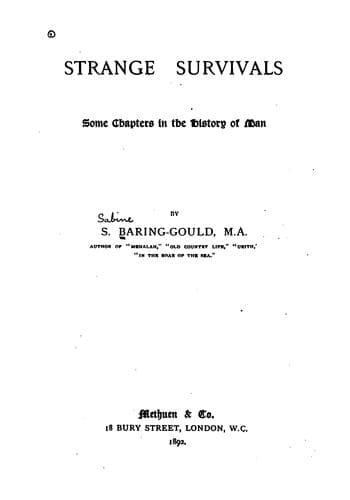
Strange Survivals: Some Chapters in the History of ManBaring-Gould, S. (Sabine)
History
Strange Survivals: Some Chapters in the History of Man
Baring-Gould, S. (Sabine)
Manners and customs -- Origin; Superstition
There is a curious little work, the contents of which are said
to have been collected by Hans Sachs, the Nuremberg cobbler and
master-singer, in 1517. This curious book was reprinted several times
in the seventeenth and early part of the eighteenth century, but it
is now somewhat scarce. It was issued without place of publication or
publisher’s name, in small form without cover. The book pretends to
have been prepared by Hans Sachs for his private use, that he might
make merriment among his friends, when drinking, and they were tired
of his songs. It does not contain any anecdotes; it is made up of a
collection of riddles more or less good, some coarse, and some profane;
but the age was not squeamish. The title under which the little work
was issued was, _Useful Table-talk, or Something for all; that is
the Happy Thoughts, good and bad, expelling Melancholy and cheering
Spirits, of Hilarius Wish-wash, Master-tiler at Kielenhausen_. The
book consists of just a hundred pages, of which a quarter are consumed
by prefaces, introductions, etc., and about thirteen filled with
postscript and index. The humours of the book are somewhat curious;
for instance, in the preliminary index of subjects it gives--“IX. The
reason why this book of Table-talk was so late in being published.”
When we turn to the place indicated for the reason, we find a blank.
There is no such reason. There is a fulsome and absurd dedication to
the “Honourable and Knightly Tileburner” who lives “By the icy ocean
near Moscow, in Lapland, one mile below Podolia and three miles above
it.”
Although we are not told in the place indicated why the little
collection was not issued immediately after the death of Hans Sachs,
nor among his works, we learn the reason elsewhere, in the preface,
where we are told that the jokes it contained were so good that a
rivalry ensued among them as to precedence, and till this was settled,
it was impossible to get the book printed. The collection contains in
all one hundred and ninety-six riddles; among them is that which gives
the date of the book, and that in a chronogram: “When was this book
of Table-talk drawn up? _Answer._ In IetzIg taVsenD fIInff hVnDert
sIbenzehenDen Iahr” (1517).
Here are some of the conundrums.--_Question._ After Adam had eaten the
forbidden fruit, did he stand or sit down?--_Ans._ Neither; he fell.
_Ques._ Two shepherds were pasturing their flocks. Said one to the
other: “Give me one of your sheep, then I shall have twice as many
sheep as you.”--“Not so,” replied the second herdsman: “give me one
of yours, and then we shall have equal flocks.” How many sheep had
each?--_Ans._ One had seven, the other five. If the first took a sheep
out of the flock of the second, he had eight, the other four; if the
contrary, each had six.
_Ques._ What is four times six?--_Ans._ 6666.
_Ques._ What does a goose do when standing on one leg?--_Ans._ Holds up
the other!
Public-domain text, read in full here on John Shaqi.
Reviews
Reviews
No reviews yet
Be the first to share your thoughts on this work.
Elsewhere in the archive
Join the Discussion
Join the discussion
Sign in to leave a comment or review.
Sign InorCreate an account