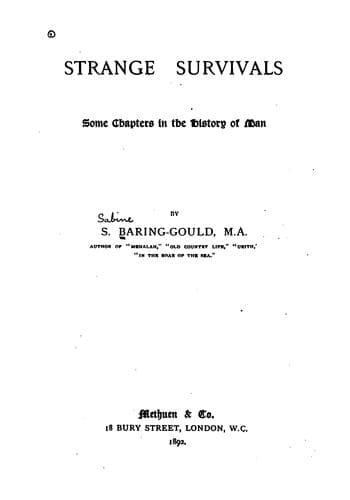
Strange Survivals: Some Chapters in the History of ManBaring-Gould, S. (Sabine)
History
Strange Survivals: Some Chapters in the History of Man
Baring-Gould, S. (Sabine)
Manners and customs -- Origin; Superstition
The Sphinx will recur to the recollection of the reader, who tore to
pieces those who could not answer its riddles. At last Creon, King of
Thebes, offered his sister, Jocasta, to anyone who could solve the
enigmas propounded by the Sphinx. Œdipus ventured, and when asked by
the monster, “What animal is four-footed in the morning, two-footed
at noon, and three-footed in the evening?” answered: “Man, who as a
babe crawls, and as an old man leans on a crutch.” The Sphinx was so
distressed at hearing its riddle solved, that it precipitated itself
from a precipice and was dashed to pieces.
The Persian hero, Sal, who was brought up by the gigantic bird Simorg,
appears before Mentuscher, Schah of Iran. The latter, forewarned that
Sal will be a danger to him, endeavours to get rid of him. However, he
first tests him with hard questions. If he answers these, he is to be
allowed to live. The first question is: “There stand twelve cypresses
in a ring, and each bears thirty boughs.” Sal replies, “These are
the twelve months, each of which has thirty days.” Another question
is--“There were two horses, one black, the other clear as crystal.”
“They are Day and Night,” replied Sal.
In English and Scottish Ballads a whole class has reference to the
importance of riddle answering.
A girl is engaged to a young man who dies. He returns from the grave
and insists on her fulfilling her engagement to him and following him
to the land of the dead. She consents on one condition, that he will
answer her riddles, or else she pleads to be spared, and the dead lover
agrees on condition that she shall answer some riddles he sets. Such
is a ballad which was formerly enacted in the farmhouses in Cornwall.
The girl sits on her bed and sighs for her dead lover. He reappears and
insists on her following him. Then she sets him tasks, and he sets her
tasks.
Those he sets her are:--
“Thou must buy me, my lady, a cambrick shirt
Whilst every grove rings with a merry antine (antienne = anthem),
And stitch it without any needle work,
O, and thou shalt be a true love of mine.
“And thou must wash it in yonder well
Where never a drop of water fell.
“And thou must hang it upon a white thorn
That never has blossomed since Adam was born.”
Those she sets him are:--
“Thou must buy for me an acre of land
Between the salt ocean and the yellow sand.
“Thou must plough it over with a horse’s horn,
And sow it all over with one pepper corn.
“Thou must reap it too with a piece of leather,
And bind the sheaf with a peacock’s feather.”
“In all stories of this kind,” says Mr. Child, in his monumental work
on English Ballads, “the person upon whom a task is imposed stands
acquitted if another of no less difficulty is desired, which must be
performed first.”
Public-domain text, read in full here on John Shaqi.
Reviews
Reviews
No reviews yet
Be the first to share your thoughts on this work.
Elsewhere in the archive
Join the Discussion
Join the discussion
Sign in to leave a comment or review.
Sign InorCreate an account