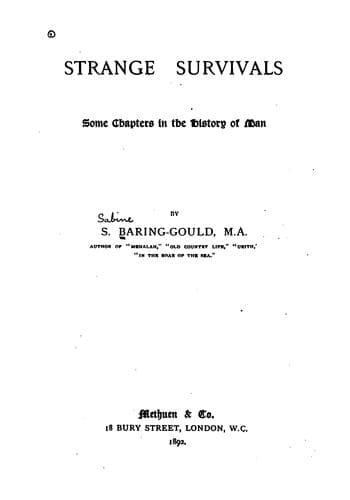
Strange Survivals: Some Chapters in the History of ManBaring-Gould, S. (Sabine)
History
Strange Survivals: Some Chapters in the History of Man
Baring-Gould, S. (Sabine)
Manners and customs -- Origin; Superstition
“Now if you had not done these things,
If you had not done all three,
I’d tear you as the withered leaves
Are torn from off the tree.”
And the maiden, released from her bond, sings:--
“Now I have mourned upon his grave
A twelvemonth and a day,
I’ll set my sail before the wind
To waft me far away.”
Another ballad of the same class is that of the knight who betrays a
maiden, and refuses to marry her unless she can answer certain riddles.
These are:--
“What is louder than a horn?
And what is sharper than a thorn?
What is broader than the way?
And what is deeper than the sea?”
The answers are:--
“Thunder is louder than a horn,
And hunger is sharper than a thorn,
Love is broader than the way,
And hell is deeper than the sea.”
Now these ballads and a crowd of folk tales that bear on the same point
show plainly enough that there was a time when quite as certainly as
there were contests of arms, so contests of wit were gone through
for great ends, sometimes with life at stake. That was a period when
there was a struggle between man and man, and the fittest survived;
but this fittest was not always the strongest animal, but the man of
keenest wit. I do not know how else to explain the universality of
these legends. The riddle is an amusement at the present day. It was
an amusement at a Greek banquet, as we learn from Plutarch. But in a
pre-historic period--in a mythic epoch--it was something very grave.
He or she who could not solve a riddle, or a succession of riddles,
forfeited life or honour.
There are two of the earliest extant rhymes of the Norse people which
hinge on the same idea, and in them the gods themselves have their
existence or honour at stake. These are the Vafthrudnis Mâl and the
Alvis Mâl, in the Elder Edda.
In the first of these Odin the god and mythical ancestor of
the Scandinavian race visits the Jute, the giant Vafthrudnir,
representative of the large-sized pre-historic race which occupied
Scandinavia, Great Britain, and Gaul. They go through a contest of
wit. He who is defeated in this trial of skill has to lose his life.
Vafthrudnir asks:--
“Tell me, Gagnrad,
Since on the floor thou wilt
Prove thy proficiency,
How is the horse called
That draws each day
Forth over mankind?”
Odin, who has called himself Gagnrad, replies:--
“Skinfaxi he is named
That the bright day draws
Forth over mankind.
Of horses is he highest esteemed
Amidst the Reid-Goths,
Light ever streams from that horse’s mane.”
Public-domain text, read in full here on John Shaqi.
Reviews
Reviews
No reviews yet
Be the first to share your thoughts on this work.
Elsewhere in the archive
Join the Discussion
Join the discussion
Sign in to leave a comment or review.
Sign InorCreate an account