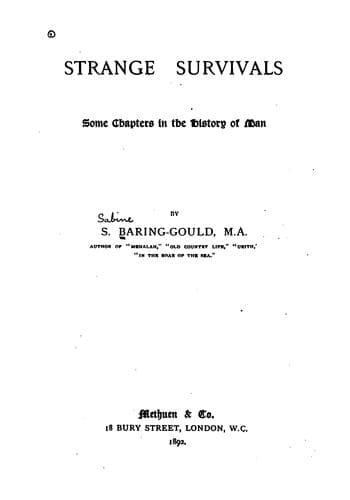
Strange Survivals: Some Chapters in the History of ManBaring-Gould, S. (Sabine)
History
Strange Survivals: Some Chapters in the History of Man
Baring-Gould, S. (Sabine)
Manners and customs -- Origin; Superstition
In the saga of Ragnar Lodbrog, the King bids Aslaug come to him
clothed yet naked, accompanied yet alone, fed yet empty. She complies
by casting off her garments but covering herself with her golden hair
that flows to her feet, taking with her a dog only, and chewing a blade
of garlic. Satisfied with her wit, Ragnar marries her. She became by
him the mother of five sons, one of whom was the ancestor of Harald
Fairhair, who made Norway into one realm under his sceptre. Aslaug
was the daughter of Sigurd and Brunhild, made familiar to us through
Wagner’s “Ring of the Nibelungen.”
The forfeits of a child’s game of the present day, to stand in the
corner on one leg, to call up the chimney, to kiss everyone in the
room--are the faintest ghostly reminiscences of the terrible forfeit,
which, in the mythic age of mankind, had to be paid by the man or woman
who became liable through lack of shrewdness in the great contest of
wit. The man who did not solve the riddle lost his life. The woman who
failed to answer the questions had to leave her race, suffer social
death, and pass over to the realm of the conquered race.
I repeat it, it is quite impossible to explain the stories of
riddle-setting which appear as a matter of most serious import as they
come to us out of a remote antiquity, and from every part of Europe
and Asia, unless we hold that there were in a pre-historic age these
contests of wit for the highest stakes, just as there were holm-gangs,
duels, like those of David and Goliath, of the Horatii and Curiatii, of
Herakles and Geryon.
But the existence of the riddle and of the forfeit attaching to
inability to answer the riddle, does not, we may be sure, begin with
such cases as the contest of Odin and Vafthrudnir, Thorr and Alvis,
Œdipus and Sphinx. As it appears thus in myth, it is a survival of a
still earlier condition of affairs.
At the present day throughout Europe, nurses ask children riddles, and
very often a forfeit attaches to inability to answer them. This points
to the riddle as a means of education of the young mind, but also as a
test of its powers. In legend and myth it does not appear as educative,
but as a test of mental power. How came it to be a test?
We know that among certain races in a primitive, even in a cultivated
condition, the feeble and halt children are cast forth to perish. It
was so with the Greeks and Romans, it was so with the Norse, it has
been so in every ancient race. I cannot but suspect, from the many
indications given by tradition, that the riddle was employed at one
time as a brain test. That not only were the physically weak cast out,
but also the mentally incapable.
Public-domain text, read in full here on John Shaqi.
Reviews
Reviews
No reviews yet
Be the first to share your thoughts on this work.
Elsewhere in the archive
Join the Discussion
Join the discussion
Sign in to leave a comment or review.
Sign InorCreate an account