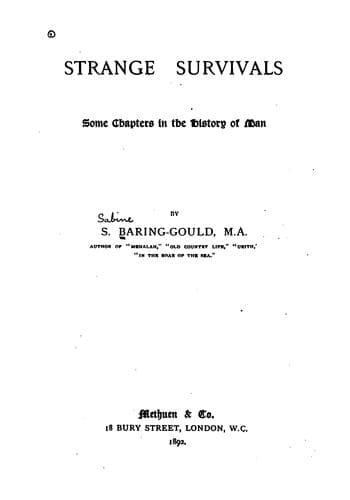
Strange Survivals: Some Chapters in the History of ManBaring-Gould, S. (Sabine)
History
Strange Survivals: Some Chapters in the History of Man
Baring-Gould, S. (Sabine)
Manners and customs -- Origin; Superstition
That was the first stage--and that is one which we conjecture that man
passed through; we have no direct evidence that it was so. Then came
the second, in which a trial of strength or of wit determined great
issues. Lastly, the riddle degenerated into a mere pastime. But as a
pastime it remains to us a monument of great interest and of great
antiquity. In every railway station in Germany is a measure. He who
is below that mark is unprofitable for Fatherland and rejected from
military service. The riddle was this mark before history dawned.
Only such as were mentally capable of solving a simple question were
considered worthy to be enrolled in the family or tribe. As in Germany
at the present day, the lad who cannot pass the examination loses
all chance of the short military service to which the man of culture
is entitled, and is subjected to the long service of a common country
lout, and the fact of his failure closes to him all professions, so was
it in the primeval world. He who could not pass through his examination
in riddles was condemned, if not to lose his life, at least to lose
caste, and the consciousness that each lad must pass through this
mental test served to sharpen intelligences, and so conduced to the
advancement of mankind.
XI.
The Gallows.
Among our national institutions there is one--the gallows--to the
roots of which, in a remote past, antiquarians have, to the best of my
knowledge, not dug, and which they have not laid bare. Possibly this
omission is due to the fact that it is not an institution of which we
are proud; possibly also to the fact that it is an institution which we
keep as clear from touching as we well can.
Nevertheless, the origin and original signification of the gallows are
too curious to be neglected. The origin is, moreover, so remote that
unless it were pointed out it would be wholly unsuspected.
In France and in Germany the wheel has occupied the place in the
history of crime which the gibbet has taken with us; and the wheel, as
I shall presently show, has as old and significant an origin.
We know pretty exactly the date of the introduction of this institution
into our island; we owe it, along with our ale and our constitutional
government, to the Anglo-Saxon invaders.
There were no gallows in Britain under the Celts. The kingdom of Kent
was founded in 449, and it was then that the gallows first made their
appearance among us; and from the Isle of Thanet spread over the whole
land.
Public-domain text, read in full here on John Shaqi.
Reviews
Reviews
No reviews yet
Be the first to share your thoughts on this work.
Elsewhere in the archive
Join the Discussion
Join the discussion
Sign in to leave a comment or review.
Sign InorCreate an account