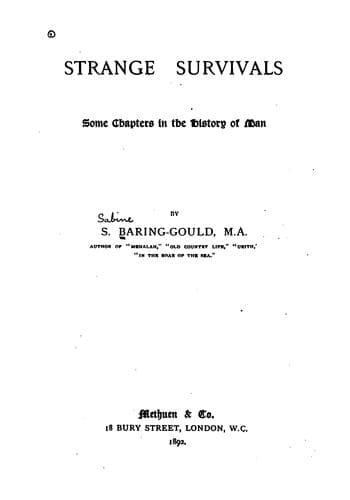
Strange Survivals: Some Chapters in the History of ManBaring-Gould, S. (Sabine)
History
Strange Survivals: Some Chapters in the History of Man
Baring-Gould, S. (Sabine)
Manners and customs -- Origin; Superstition
We will now consider some holes of a different description, that are
not actual perforations. A custom very general in Roman Catholic
countries must have struck travellers: it is that of placing cups,
basins, or other concave vessels on graves. The purpose is that they
may be filled with holy water--or if not with that, then with the dew
of heaven. The friends, kindred, or charitable as they pass dip a
little brush in the basin and sprinkle the grave with the water. This
is a symbolic act, nothing more. It means that the visitor to the grave
wishes well to the dead, and offers a prayer for the refreshment of
the departed soul. That soul may be in purgatory, and he who sprinkles
the grave knows that no drops of water thrown on the mound can slake
the fire that tortures the soul, but he acts as though he thought that
the soul still tenanted the body, and could be refreshed by the water
thrown on his grave. I do not believe this usage to have received any
formal sanction; it is a survival of a much earlier usage that has been
given an altered signification. It is not a rational proceeding, but is
not one particle more irrational than our putting wreaths and crosses
of flowers on the graves of those we have loved. I remember a daughter
planting ferns of many sorts round her mother’s tomb, “because mother
was so very fond of ferns.” But those who thus act, when they consider,
know well enough that what lies underground is the decaying husk, and
that the soul, the true being, is elsewhere. Nevertheless, the mind, by
force of custom and natural tendency, persists in associating soul with
body after death, and the dead lady was given her ferns because they
continued to give her pleasure, whilst lying in her grave, precisely as
the Tartar chief is given his horse and his wives slain and laid about
him in his cairn.
The original signification of the basin or cup on the tomb was that
of a vessel to contain the drink supplied to the dead. The dead man
continued to eat and drink in his cairn or dolmen, and the relatives
supplied him with what he required.
Public-domain text, read in full here on John Shaqi.
Reviews
Reviews
No reviews yet
Be the first to share your thoughts on this work.
Elsewhere in the archive
Join the Discussion
Join the discussion
Sign in to leave a comment or review.
Sign InorCreate an account