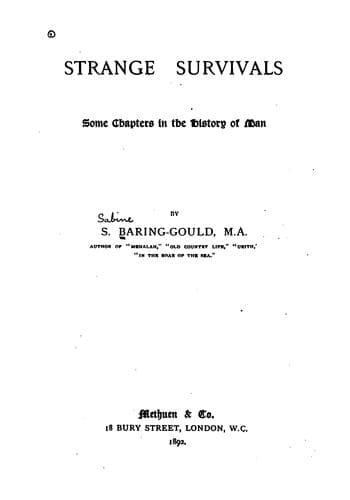
Strange Survivals: Some Chapters in the History of ManBaring-Gould, S. (Sabine)
History
Strange Survivals: Some Chapters in the History of Man
Baring-Gould, S. (Sabine)
Manners and customs -- Origin; Superstition
As far as we can judge, the dwellers in bee-hive huts were the same as
those who erected the rude stone monuments, but it does not follow that
the Megalithic monument builders did not impose their customs on the
race they conquered; and indeed it is possible, even probable, that a
people conquering them may have adopted their religious ideas and their
methods of interment.
It is curious to note how that in legend the subjugated people are
supposed to live in earth mounds. No story is more common than that
of a man passing a mound at night and seeing it open, and finding
that merriment and drinking are going on within. Sometimes children
are snatched away, and are brought up in these mounds. He who desires
to have a sword of perfect temper goes to one of the mounds, taps,
and bargains with the mound-dweller to make him a sword. The name now
given to the race--not a pure, but a mixed one--that occupied the land
before the dawn of history, is Ivernian. It was a dark-haired and
sallow-complexioned race. The Kelt was fair; and if in Ireland, and in
Cornwall, and in France so much dark hair and dusky skin is found, this
is due to the self-assertion of the primitive race that was subjugated
by the blue-eyed, fair-haired conquerors from the Black Sea and the
Danube.
What was the conquered race? “What,” asks the author of “Chaldæa,” in
the “Story of the Nations,” “What is this great race which we find
everywhere at the very roots of history, so that not only ancient
tradition calls them ‘the oldest of men,’ but modern science more and
more inclines to the same opinion? Whence came it?” And the answer Mme.
Ragozin gives to the question is--that this was the yellow Turanian
people which overflowed from the steppes of Northern Asia, which
carried with it thence acquaintance with the metals, and through this
acquaintance established itself as masters wherever it went. That may
be, but before this Ivernian race arrived in the west, whatever it was,
it found that man had been on the soil before it--aye, and for ages on
ages--occupying caves, hunting the reindeer and the horse, ignorant
of the art of the potter, and yet in some particulars his superior in
intellectual power.[16]
Public-domain text, read in full here on John Shaqi.
Reviews
Reviews
No reviews yet
Be the first to share your thoughts on this work.
Join the Discussion
Join the discussion
Sign in to leave a comment or review.
Sign InorCreate an account