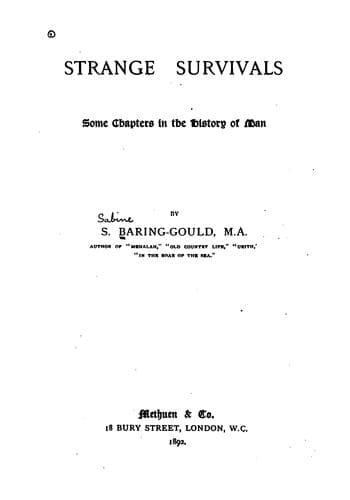
Strange Survivals: Some Chapters in the History of Man — John Shaqi
Strange Survivals: Some Chapters in the History of ManBaring-Gould, S. (Sabine)
History
Strange Survivals: Some Chapters in the History of Man
Baring-Gould, S. (Sabine)
Manners and customs -- Origin; Superstition
and occupied both Palestine and Arabia. The Palestine exploration has
led to the discovery of numerous remains in that land, identical in
character with those found everywhere else where this people sojourned.
And Mr. Palgrave was startled to find that Arabia had its Stonehenges
precisely like that which figures on the Wiltshire Downs.
The researches of French antiquaries have led to the conclusion that
the men who set up these great stone monuments were those who used
weapons of polished flint and chert. Precisely the same conclusion
has been reached by the archæologists of Scotland. Bronze was indeed
employed, but at a later period; and then bronze and polished stone
were used together.
In the tumuli of Great Britain and of Gaul, two distinct types of heads
are found. These are the long and the round bullet skull. In France,
before the dawn of history, there seems to have been as great a mixture
of races as there is at present. It is not possible for us in England
to determine the succession of peoples and civilisations as nicely as
can be done in France, for we have not such deposits of the remains of
successive populations superposed as they have in Perigord. Under the
overhanging limestone cliffs on the Vézère, men lived in succession one
age on another to the present day, from the first who set foot on the
soil, and by digging through these beds to the depth of forty feet, we
obtain the remains of these men in their order--
Modern men.
Mediæval.
Gallo-Roman (coins).
Gauls (iron weapons).
Neolithic men { bronze.
{ polished stone.
[Gap. This gap questioned.]
{ of ivory and bone weapons.
Palæolithic men { of delicately-worked flint blades.
{ of rudely-worked flint weapons. { Moustier.
{ Chelles.[15]
The Palæolithic men were the great reindeer and horse hunters, and the
development of their civilisation may be followed in their remains.
What became of them we know not. Perhaps they migrated north after the
reindeer.
The Neolithic men erected the rude stone monuments, the circles of
upright stones. They were the men of Stonehenge and of Carnac. But this
race was not pure. Its skulls exhibit a great mixture of character
and kind, and it is probable that it took up into it other peoples
subjugated on its way west and south. Perhaps it also was conquered. We
cannot tell; but it seems from certain indications that it was so, and
that by the metal-working race.
When the Gaels and Cymri invaded our isles, they found them peopled,
and peopled by various races, and these they in turn subjugated.
We know but very little of the primitive populations of our isles
and of Europe; and a good deal of what we think we know is due to
guesswork based on a few observations.
Public-domain text, read in full here on John Shaqi.
Reviews
Reviews
No reviews yet
Be the first to share your thoughts on this work.
Join the Discussion
Join the discussion
Sign in to leave a comment or review.
Sign InorCreate an account