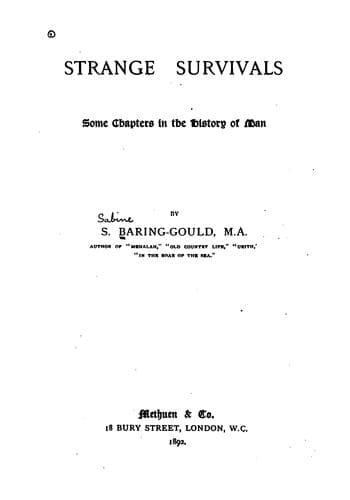
Strange Survivals: Some Chapters in the History of ManBaring-Gould, S. (Sabine)
History
Strange Survivals: Some Chapters in the History of Man
Baring-Gould, S. (Sabine)
Manners and customs -- Origin; Superstition
The curious festival of the Car of Fire observed on Easter Eve every
year at Florence carries us back to a remote period when fire was a
sacred and mysterious thing. As is well known, in the Eastern Church,
also in the Roman Catholic Church, all fires are extinguished before
Easter; and in the Cathedral, the Bishop, on Easter morning, strikes
new fire, blesses it, and all the hearths in the city receive the new
fire from this blessed spark. It is vulgarly supposed that the old fire
has got worn out, and has lost its full vigour by use throughout the
year, and that the new fire is full of restless and youthful energy.
There can be little doubt that this idea goes back to a remote and
Pagan time, and the Church accepted what was a common custom, and gave
it, or tried to give it, a new and Christian idea, connecting it with
the resurrection of Him who is the Light of the World. The same custom
of striking and blessing new fire exists in many parts of the West as
well as the East, and is sanctioned by the Roman Church. But nowhere
does this ancient usage assume so quaint and picturesque a form as
at Florence. There, however, the primitive significance is completely
forgotten, and the people have endeavoured to explain the ceremony
which I will now describe in various mutually contradictory ways.
On Easter Eve, four magnificent white oxen, their huge horns wreathed
with flowers, and with garlands about them, as though they were being
conveyed to sacrifice, draw a huge car, painted black, some twenty-five
feet high, pyramidal in shape, and crowned with a mural coronet,
into the piazza before the west doors of the white marble cathedral.
The car is itself wreathed with flowers to its highest pinnacle, and
with the flowers various fireworks are interspersed. As soon as this
great trophy is in place, and the oxen unyoked, the west doors of the
cathedral are thrown open, and a rope is strained from the top of the
car to a pillar that is erected in front of the high altar, a distance
of some two hundred yards. On this cord is seen perched a white dove,
composed of some white substance, probably plaster. For two hours
before the event of the day takes place the great piazza and the nave
of the vast cathedral are crowded. Villagers from all the country round
have arrived; but there are also present plenty of townsfolk, and
strangers from foreign lands. At half-past eleven, the archbishop and
all his clergy come in procession down the body of the church, pass
out of the west doors, and make the circuit of the cathedral. Before
twelve o’clock strikes they are again in their places in the choir.
At the stroke of noon the newly-blessed fire is applied to a train
of gunpowder at the foot of the pillar. In another moment the pigeon
skims down the nave, pouring out a shower of fire, sweeps out of the
west door of the cathedral, reaches the trophy in the square, sets
fire to a fusee there, then turns and flies back along the rope, still
Public-domain text, read in full here on John Shaqi.
Reviews
Reviews
No reviews yet
Be the first to share your thoughts on this work.
Elsewhere in the archive
Join the Discussion
Join the discussion
Sign in to leave a comment or review.
Sign InorCreate an account