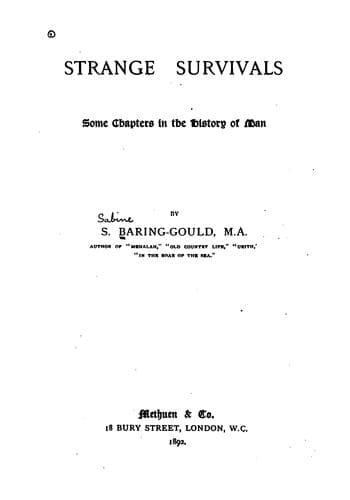
Strange Survivals: Some Chapters in the History of ManBaring-Gould, S. (Sabine)
History
Strange Survivals: Some Chapters in the History of Man
Baring-Gould, S. (Sabine)
Manners and customs -- Origin; Superstition
M. de la Loubière, envoy extraordinary from the French King in 1687
and 1688 to the King of Siam, says in his narrative that the use of
the umbrella was granted by the sovereign to certain highly honoured
subjects. An umbrella with several rings of very wide expansion was
the prerogative of the king alone, but to certain nobles was granted
by princely condescension the right to have their heads and faces
screened from the sun by smaller shades. In his quaint old French, M.
de la Loubière says that in the audience-chamber of the king:--“Pour
tout meuble il n’y a que trois para-sols, un devant la fenêtre, á neuf
ronds, et deux á sept ronds aux deux côtéz de la fenêtre. Le para-sol
est en ce Pais là, ce que le Dais est en celui-ci”--that is to say, a
mark of the highest power.
The Mahratta princes had the title of “Lords of the Umbrella.” The
chàta of these princes is large and heavy, and requires a special
attendant to hold it, in whose custody this symbol of sovereignty
reposes.
In Ava it seems to have been part of the royal title that the sovereign
was “King of the White Elephant and Lord of Twenty-four Umbrellas.” In
1855 the King of Burmah directed a letter to the Marquis of Dalhousie
in which he styles himself “His glorious and most excellent Majesty,
reigning over the umbrella-wearing princes of the East.”
Among the Arabs the umbrella is a mark of distinction. Niebuhr says
that it is a privilege confined to princes of the blood to use an
umbrella.[24]
In the East the umbrella has come to be regarded as connected with
royalty as much as the crown and the throne; and among the Buddhists
it has remained so. Four feet from the throne of the Great Mogul, as
described by Tavernier, were two spread umbrellas of red velvet fringed
with pearls, the sticks of which were wreathed with pearls. Du Halde
says that in the Imperial palace at Pekin there were umbrellas always
ready for the Emperor; and when he rode out, a canopy was borne on two
sticks over his head to shade him and his horse. Of Sultan Mohammed
Aladdin we are told that he adopted insignia of majesty hitherto used
in India and Persia and unknown in Islam; among these was a canopy
or umbrella held over his head when he went abroad. Of one Sultan’s
umbrella we are told that it was of yellow embroidered with gold and
surmounted by a silver dove.
But as the umbrella was the symbol of majesty held over the king’s
head, it behoved the royal palace to imitate the same, and by its
structure show to all that it was the seat of majesty. Thus came
into use the cupola or dome, and what was given to the king’s house
was given also to the temples. In Perret and Chapui’s conjectural
reconstruction of the temple of Belus, near Babylon, above the seven
stages of the mighty pyramid, is the shrine of the god surmounted by a
dome. In all likelihood this really was the apex of the pyramid; the
dome was a structural umbrella held over the supreme god.
Public-domain text, read in full here on John Shaqi.
Reviews
Reviews
No reviews yet
Be the first to share your thoughts on this work.
Elsewhere in the archive
Join the Discussion
Join the discussion
Sign in to leave a comment or review.
Sign InorCreate an account