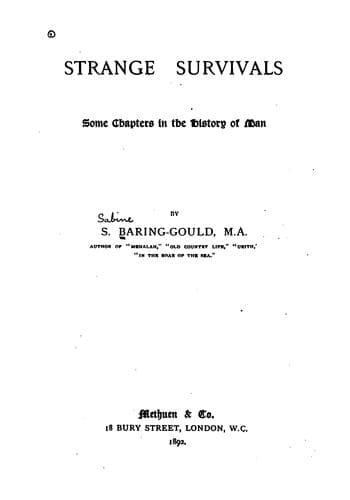
Strange Survivals: Some Chapters in the History of ManBaring-Gould, S. (Sabine)
History
Strange Survivals: Some Chapters in the History of Man
Baring-Gould, S. (Sabine)
Manners and customs -- Origin; Superstition
To an ordinary cultured Pagan of Rome, or Greece, or Egypt, idolatry
was impossible. The gods, figured in marble and bronze, were to them
symbols and nothing else, precisely as to us the letters of the
alphabet are symbols of certain sounds, and the pictographic characters
of cuneiform and hieroglyphic writing were anciently symbols of certain
ideas. So also idolatry is absolutely impossible to anyone who has
gone through the elements of modern education. Religious statues and
pictures are historic representations of personages and events in
the sacred story, but to look upon them with the eyes of an Ostjak
or a child of six is a psychological impossibility, except only
for such as are mentally stunted like the Beguine of Ghent. It is,
therefore, without the smallest scruple that we can employ imagery
in our churches, knowing that the possibility of misusing it is gone
past reversion to it in nine hundred and ninety-nine persons out of
a thousand, and that the thousandth person who would misuse it is
incapable of any other religious exercise, and it were better that he
had some religious conceptions, however low these were, than none at
all.
To draw this moral has not been my object in penning this article, but
to direct the attention of the intelligent to the nursery, and show
them how that the elements for the study of primitive culture, the
means of following the development of ideas in man are to be found
wherever there are little children.
VIII.
Revivals.
Of the three factors that go to make up man--body, intellect, and the
spiritual faculty, the last has been allowed somewhat to fall into
neglect in the present age, when special stress has been laid on the
education and development of the intellect. Nevertheless it is a factor
that must not be ignored, and it is one that is likely to revenge
itself for neglect by abnormal action.
In the Middle Ages it was the reverse; under the preponderating
influence of the Church, the spiritual faculty was cultivated to
extreme of mysticism, and the intellect on one side, and the body on
the other, hardly received sufficient recognition. When an ascetic
would neither think out a problem nor keep himself clean, he exhibited
a monstrosity, not as repulsive, but as certainly a monstrosity,
as one of the gladiators depicted on the pavement of the Baths of
Caracalla--this latter, a man cultivated to the highest point of
animal strength and physical activity. It is probable that a purely
intellectual man without idealism, without religiosity, is as much a
monster as either of the other, though not in the nineteenth century as
repugnant to us as they are.
Public-domain text, read in full here on John Shaqi.
Reviews
Reviews
No reviews yet
Be the first to share your thoughts on this work.
Elsewhere in the archive
Join the Discussion
Join the discussion
Sign in to leave a comment or review.
Sign InorCreate an account