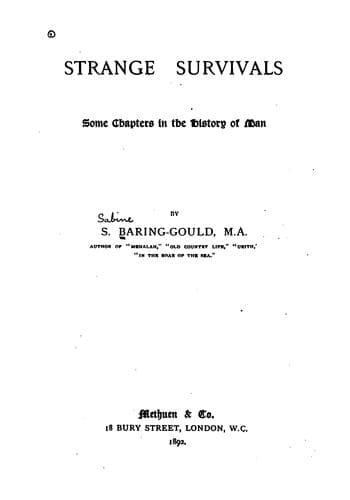
Strange Survivals: Some Chapters in the History of ManBaring-Gould, S. (Sabine)
History
Strange Survivals: Some Chapters in the History of Man
Baring-Gould, S. (Sabine)
Manners and customs -- Origin; Superstition
Madness, epilepsy, catalepsy, hysteria, in fact all nervous maladies
are at present little understood by science, and among rude nations,
where there is no science, are not understood at all, and are regarded
with superstitious terror. The violence of the patient, the fancies
that possess him, his incoherent cries, the distortion of his body,
the alteration in his features, all seem to point out that he has
fallen under the domination of a foreign power, and such a person is
said to be _possessed_. His actions, his words, are no longer his own,
but those of the spirit that occupies his body. There was not of old,
nor is there still among savages, any sharp distinction between good
spirits and bad. All spirits are those of the dead. It is only by those
who have advanced to a higher stage that these are classified as angels
or devils. In Baron Wrangel’s “North Polar Travels,” already quoted,
is another significant passage which illustrates this point. He says
that in Northern Siberia an epidemic disease called the Mirak appears,
which, according to the universal belief of the people, proceeds from
the ghost of a dead sorceress entering into and tormenting the patient.
But Wrangel says, “The Mirak appears to me to be only an extreme form
of hysteria; the persons attacked are chiefly women.”
Our word _mania_ traces back to the period when the madman was supposed
to be possessed by the _manes_, the spirit of some dead man; but such
an idea was already abandoned by the classic Roman, who gave the word
to us.
As already said, it was inevitable that Schamanism should co-exist
along with an organised religion, for only one portion of a people
would have made sufficient progress to be able to receive a dogmatic
faith and accept a formulated worship. There would always remain a
substratum of ignorance and unintelligence which would have recourse
to diviners and dealers with familiar spirits, that is to Schamans
or medicine-men. And now we can understand the true position of
the Witch of Endor. The faith of the Jewish people had taken shape;
it had its monotheistic creed, its altars, and its priesthood, but
the religious development of the people was not on a level with the
scheme of Mosaism. The law was formal, unspiritual--that is to say,
unsensational--to those to whom the only religion that was acceptable
was one of vague spiritualism and ecstatic hallucination. Saul himself
was one of these. As long as all went well with him he adhered to the
authorised religion, but the moment he was in real distress and alarm
he had recourse to the baser, proscribed system, level with his own low
spiritual perceptions.
Public-domain text, read in full here on John Shaqi.
Reviews
Reviews
No reviews yet
Be the first to share your thoughts on this work.
Elsewhere in the archive
Join the Discussion
Join the discussion
Sign in to leave a comment or review.
Sign InorCreate an account