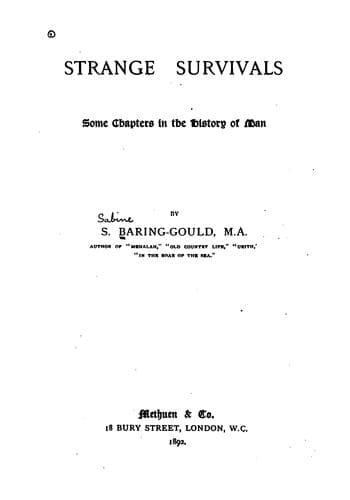
Strange Survivals: Some Chapters in the History of ManBaring-Gould, S. (Sabine)
History
Strange Survivals: Some Chapters in the History of Man
Baring-Gould, S. (Sabine)
Manners and customs -- Origin; Superstition
He had not been long gone before the natural result of an
indiscriminate conversion made itself apparent, and St. Paul had to
write to the young Church at Corinth a letter which has been lost or
suppressed. This was followed by a second, and that by a third, and we
have got only the two latter. Probably, the Church of Corinth thought
it best to put the first in the fire and not publish its shame. But
the second and third--the first and second, as we call them--throw a
tolerably clear light on the state of this Church.
There were dissensions in it, and no wonder; then scandal, and,
again,--no wonder. Of the dissensions I need not speak.
First among the scandals came the Love Feasts. The feast was instituted
in order that all the faithful might meet, and eat and drink together,
the rich contributing the provisions and sitting down with the poor. It
is not to be confounded with the Holy Eucharist, which was something
quite distinct. The Love Feast took place at night, the Eucharist in
the early morning.
However excellent in intention the institution might be, in a very
short time it was abused. The well-to-do brought food and wine with
them, and ate and drank by themselves, apart from the slaves and
the members whom poverty prevented from contributing. The poor were
compelled to look hungrily on, while the rich brethren, having more
than sufficed, indulged to excess. One was hungry, and another was
drunken.
It is not difficult to trace the origin of these Love Feasts; they
were a local adaptation from the heathen ceremonial of the Temple of
Aphrodite.
The Greeks had mysteries in their principal temples, into which the
devout were initiated. Baptism was one of the initiatory acts. Then
the neophytes were taught certain secret doctrines which they were
forbidden to reveal to the profane without. After that they partook
together of a sacred feast, and then ensued ecstatic raptures,
hysterical ravings, and orgies of a licentious character in those
shrines dedicated to the goddess of love.
The newly converted Christians of Corinth were desirous of getting
as much excitement out of their new religion as they could. So they
treated Christian baptism as an initiation into Christian mysteries;
they instituted the Love Feast as a close reproduction of the banquet
with which they were familiar in the Temple of Aphrodite, and then
followed a condition of disorder very little more decent than the
heathen orgies.
Public-domain text, read in full here on John Shaqi.
Reviews
Reviews
No reviews yet
Be the first to share your thoughts on this work.
Elsewhere in the archive
Join the Discussion
Join the discussion
Sign in to leave a comment or review.
Sign InorCreate an account