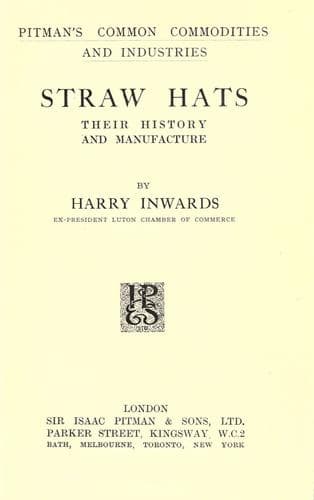
Straw Hats: Their history and manufactureInwards, Harry
History
Straw Hats: Their history and manufacture
Inwards, Harry
Hats; Straw industries
But at last competitive chemists discovered that the quantity of straw
plait required for bleaching was of such magnitude, while the really
good bleaching plait was comparatively so small in quantity, that
it would be worth their while to make researches in the direction
of a bleach for inferior coloured straws. Between 1885 and 1890 many
experiments were made, with naturally variable results. It must not
be overlooked, that plaits were still required by the trade to be of
a “straw” colour, and the first efforts of the “new bleacher” were
towards this end. But the process that gave most promise being actually
an oxydization was more in the nature of a dye than a bleach in one
respect, viz., that it apparently changed the nature of the material,
in fact some of the bleachers to differentiate in the trade between the
new process and the old called the later arrival a “White Dye.” It was
soon found that an extended application of the process would entirely
eliminate the varying tones of mixed “Punta” and “Pedale” straws and
would make the plait a perfectly dull white like paper, but at the same
time it tended to materially injure the fabric of the straw. There
was naturally no demand for any such results, the “paper white” could
easily be obtained on “chip” plaits, and the only effect required was
to reduce mottled coloured natural plaits to sufficient uniformity of
good straw white colour. Moreover, the absolute “deadness” of the white
produced took away all the beautiful lustre of the straw which it was
desirable to retain; and the weakening of the fibre by the chemical
process was entirely inimical to the subsequent proper sewing and
finishing of the hat.
However, a process was found that met all requirements as far as lustre
and strength were concerned. There was still a tendency to kill the
straw colour, but subsequent investigations have reduced that to a
minimum, and to-day the bleaches on straw plaits leave nothing to be
desired.
As far as chip and Tagal plaits were concerned there was not the
occasion to preserve the natural colours of the fibre. White chip was
always required “paper white,” and although some of the hemp fibres of
Tagal were of a flaxen colour, most of that exported from Japan was
distinctly on the white side, and, therefore, from the first, this
process of bleaching has been helpful to all plaits made of these two
materials.
Moreover, the modern methods are especially adaptable for hood hats,
inasmuch as the process dispenses with scrubbing by hand. To Panamas,
although previously the colour had been fairly good, the new bleach
has been a great help, and has enabled Panamas of fine colour to be
universal.
Public-domain text, read in full here on John Shaqi.
Reviews
Reviews
No reviews yet
Be the first to share your thoughts on this work.
Join the Discussion
Join the discussion
Sign in to leave a comment or review.
Sign InorCreate an account