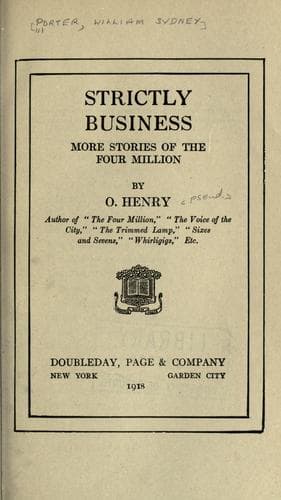
Strictly Business: More Stories of the Four MillionHenry, O.
Philosophy
Strictly Business: More Stories of the Four Million
Henry, O.
New York (N.Y.) -- Social life and customs -- Fiction
Jacob talked on, asking him about his work, how he spent his leisure
time, and what his ambitions were. The more he saw and heard of Thomas,
the better he liked him. He had not met many young men in Bagdad so
frank and wholesome.
“I would like to have you visit my house,” he said. “I might help you
in investing or laying out your money. I am a very wealthy man. I have
a daughter about grown, and I would like for you to know her. There are
not many young men I would care to have call on her.”
“I’m obliged,” said Thomas. “I’m not much at making calls. It’s
generally the side entrance for mine. And, besides, I’m engaged to a
girl that has the Delaware peach crop killed in the blossom. She’s a
parlor maid in a house where I deliver goods. She won’t be working
there much longer, though. Say, don’t forget to give your friend my
grandfather’s best regards. You’ll excuse me now; my wagon’s outside
with a lot of green stuff that’s got to be delivered. See you again,
sir.”
At eleven Thomas delivered some bunches of parsley and lettuce at the
Spraggins mansion. Thomas was only twenty-two; so, as he came back, he
took out the handful of five-hundred-dollar bills and waved them
carelessly. Annette took a pair of eyes as big as creamed onion to the
cook.
“I told you he was a count,” she said, after relating. “He never would
carry on with me.”
“But you say he showed money,” said the cook.
“Hundreds of thousands,” said Annette. “Carried around loose in his
pockets. And he never would look at me.”
“It was paid to me to-day,” Thomas was explaining to Celia outside. “It
came from my grandfather’s estate. Say, Cele, what’s the use of waiting
now? I’m going to quit the job to-night. Why can’t we get married next
week?”
“Tommy,” said Celia. “I’m no parlor maid. I’ve been fooling you. I’m
Miss Spraggins—Celia Spraggins. The newspapers say I’ll be worth forty
million dollars some day.”
Thomas pulled his cap down straight on his head for the first time
since we have known him.
“I suppose then,” said he, “I suppose then you’ll not be marrying me
next week. But you _can_ whistle.”
“No,” said Celia, “I’ll not be marrying you next week. My father would
never let me marry a grocer’s clerk. But I’ll marry you to-night,
Tommy, if you say so.”
Old Jacob Spraggins came home at 9:30 P. M., in his motor car. The make
of it you will have to surmise sorrowfully; I am giving you
unsubsidized fiction; had it been a street car I could have told you
its voltage and the number of wheels it had. Jacob called for his
daughter; he had bought a ruby necklace for her, and wanted to hear her
say what a kind, thoughtful, dear old dad he was.
There was a brief search in the house for her, and then came Annette,
glowing with the pure flame of truth and loyalty well mixed with envy
and histrionics.
Public-domain text, read in full here on John Shaqi.
Reviews
Reviews
No reviews yet
Be the first to share your thoughts on this work.
Elsewhere in the archive
Join the Discussion
Join the discussion
Sign in to leave a comment or review.
Sign InorCreate an account