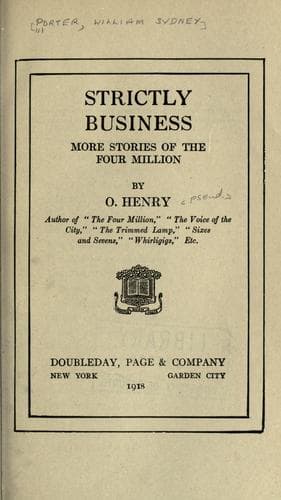
Strictly Business: More Stories of the Four MillionHenry, O.
Philosophy
Strictly Business: More Stories of the Four Million
Henry, O.
New York (N.Y.) -- Social life and customs -- Fiction
“How goes the writing?” asked the editor.
“Look at me,” said Dawe, “for your answer. Now don’t put on that
embarrassed, friendly-but-honest look and ask me why I don’t get a job
as a wine agent or a cab driver. I’m in the fight to a finish. I know I
can write good fiction and I’ll force you fellows to admit it yet. I’ll
make you change the spelling of ‘regrets’ to ‘c-h-e-q-u-e’ before I’m
done with you.”
Editor Westbrook gazed through his nose-glasses with a sweetly
sorrowful, omniscient, sympathetic, skeptical expression—the
copyrighted expression of the editor beleagured by the unavailable
contributor.
“Have you read the last story I sent you—‘The Alarum of the Soul’?”
asked Dawe.
“Carefully. I hesitated over that story, Shack, really I did. It had
some good points. I was writing you a letter to send with it when it
goes back to you. I regret—”
“Never mind the regrets,” said Dawe, grimly. “There’s neither salve nor
sting in ’em any more. What I want to know is _why_. Come now; out with
the good points first.”
“The story,” said Westbrook, deliberately, after a suppressed sigh, “is
written around an almost original plot. Characterization—the best you
have done. Construction—almost as good, except for a few weak joints
which might be strengthened by a few changes and touches. It was a good
story, except—”
“I can write English, can’t I?” interrupted Dawe.
“I have always told you,” said the editor, “that you had a style.”
“Then the trouble is—”
“Same old thing,” said Editor Westbrook. “You work up to your climax
like an artist. And then you turn yourself into a photographer. I don’t
know what form of obstinate madness possesses you, but that is what you
do with everything that you write. No, I will retract the comparison
with the photographer. Now and then photography, in spite of its
impossible perspective, manages to record a fleeting glimpse of truth.
But you spoil every dénouement by those flat, drab, obliterating
strokes of your brush that I have so often complained of. If you would
rise to the literary pinnacle of your dramatic senses, and paint them
in the high colors that art requires, the postman would leave fewer
bulky, self-addressed envelopes at your door.”
“Oh, fiddles and footlights!” cried Dawe, derisively. “You’ve got that
old sawmill drama kink in your brain yet. When the man with the black
mustache kidnaps golden-haired Bessie you are bound to have the mother
kneel and raise her hands in the spotlight and say: ‘May high heaven
witness that I will rest neither night nor day till the heartless
villain that has stolen me child feels the weight of another’s
vengeance!’”
Editor Westbrook conceded a smile of impervious complacency.
“I think,” said he, “that in real life the woman would express herself
in those words or in very similar ones.”
Public-domain text, read in full here on John Shaqi.
Reviews
Reviews
No reviews yet
Be the first to share your thoughts on this work.
Elsewhere in the archive
Join the Discussion
Join the discussion
Sign in to leave a comment or review.
Sign InorCreate an account