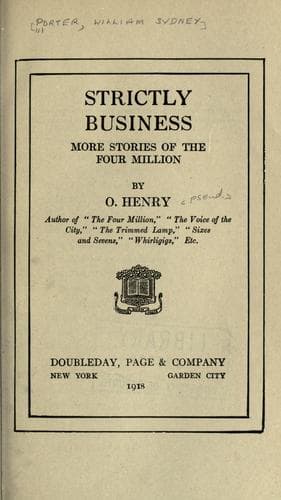
Strictly Business: More Stories of the Four MillionHenry, O.
Philosophy
Strictly Business: More Stories of the Four Million
Henry, O.
New York (N.Y.) -- Social life and customs -- Fiction
She stooped low and reached down somewhere into a swirl of flirted
draperies, heliotrope and black. An elastic snapped, she threw on the
table toward Cork a folded wad of bills. The money slowly straightened
itself with little leisurely jerks.
“Take that, Jimmy, and let’s go,” said the girl. “I’m declarin’ the
usual dividends, Maguire,” she said to the officer. “You had your usual
five-dollar graft at the usual corner at ten.”
“A lie!” said the cop, turning purple. “You go on my beat again and
I’ll arrest you every time I see you.”
“No, you won’t,” said the girl. “And I’ll tell you why. Witnesses saw
me give you the money to-night, and last week, too. I’ve been getting
fixed for you.”
Cork put the wad of money carefully into his pocket, and said: “Come
on, Fanny; let’s have some chop suey before we go home.”
“Clear out, quick, both of you, or I’ll—”
The cop’s bluster trailed away into inconsequentiality.
At the corner of the street the two halted. Cork handed back the money
without a word. The girl took it and slipped it slowly into her
hand-bag. Her expression was the same she had worn when she entered
Rooney’s that night—she looked upon the world with defiance, suspicion
and sullen wonder.
“I guess I might as well say good-bye here,” she said dully. “You won’t
want to see me again, of course. Will you—shake hands—Mr. McManus.”
“I mightn’t have got wise if you hadn’t give the snap away,” said Cork.
“Why did you do it?”
“You’d have been pinched if I hadn’t. That’s why. Ain’t that reason
enough?” Then she began to cry. “Honest, Eddie, I was goin’ to be the
best girl in the world. I hated to be what I am; I hated men; I was
ready almost to die when I saw you. And you seemed different from
everybody else. And when I found you liked me, too, why, I thought I’d
make you believe I was good, and I was goin’ to be good. When you asked
to come to my house and see me, why, I’d have died rather than do
anything wrong after that. But what’s the use of talking about it? I’ll
say good-by, if you will, Mr. McManus.”
Cork was pulling at his ear. “I knifed Malone,” said he. “I was the one
the cop wanted.”
“Oh, that’s all right,” said the girl listlessly. “It didn’t make any
difference about that.”
“That was all hot air about Wall Street. I don’t do nothin’ but hang
out with a tough gang on the East Side.”
“That was all right, too,” repeated the girl. “It didn’t make any
difference.”
Cork straightened himself, and pulled his hat down low. “I could get a
job at O’Brien’s,” he said aloud, but to himself.
“Good-by,” said the girl.
“Come on,” said Cork, taking her arm. “I know a place.”
Two blocks away he turned with her up the steps of a red brick house
facing a little park.
“What house is this?” she asked, drawing back. “Why are you going in
there?”
A street lamp shone brightly in front. There was a brass nameplate at
one side of the closed front doors. Cork drew her firmly up the steps.
“Read that,” said he.
Public-domain text, read in full here on John Shaqi.
Reviews
Reviews
No reviews yet
Be the first to share your thoughts on this work.
Elsewhere in the archive
Join the Discussion
Join the discussion
Sign in to leave a comment or review.
Sign InorCreate an account