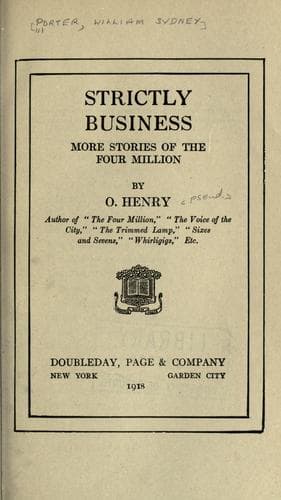
Strictly Business: More Stories of the Four MillionHenry, O.
Philosophy
Strictly Business: More Stories of the Four Million
Henry, O.
New York (N.Y.) -- Social life and customs -- Fiction
Plainly dressed, old Tom Crowley left his Madison Avenue palace, and
walked westward and then south. As he stepped to the sidewalk, Fate,
who holds the ends of the strings in the central offices of all the
enchanted cities pulled a thread, and a young man twenty blocks away
looked at a wall clock, and then put on his coat.
James Turner worked in one of those little hat-cleaning establishments
on Sixth Avenue in which a fire alarm rings when you push the door
open, and where they clean your hat while you wait—two days. James
stood all day at an electric machine that turned hats around faster
than the best brands of champagne ever could have done. Overlooking
your mild impertinence in feeling a curiosity about the personal
appearance of a stranger, I will give you a modified description of
him. Weight, 118; complexion, hair and brain, light; height, five feet
six; age, about twenty-three; dressed in a $10 suit of greenish-blue
serge; pockets containing two keys and sixty-three cents in change.
But do not misconjecture because this description sounds like a General
Alarm that James was either lost or a dead one.
_Allons!_
James stood all day at his work. His feet were tender and extremely
susceptible to impositions being put upon or below them. All day long
they burned and smarted, causing him much suffering and inconvenience.
But he was earning twelve dollars per week, which he needed to support
his feet whether his feet would support him or not.
James Turner had his own conception of what happiness was, just as you
and I have ours. Your delight is to gad about the world in yachts and
motor-cars and to hurl ducats at wild fowl. Mine is to smoke a pipe at
evenfall and watch a badger, a rattlesnake, and an owl go into their
common prairie home one by one.
James Turner’s idea of bliss was different; but it was his. He would go
directly to his boarding-house when his day’s work was done. After his
supper of small steak, Bessemer potatoes, stooed (not stewed) apples
and infusion of chicory, he would ascend to his fifth-floor-back hall
room. Then he would take off his shoes and socks, place the soles of
his burning feet against the cold bars of his iron bed, and read Clark
Russell’s sea yarns. The delicious relief of the cool metal applied to
his smarting soles was his nightly joy. His favorite novels never
palled upon him; the sea and the adventures of its navigators were his
sole intellectual passion. No millionaire was ever happier than James
Turner taking his ease.
When James left the hat-cleaning shop he walked three blocks out of his
way home to look over the goods of a second-hand bookstall. On the
sidewalk stands he had more than once picked up a paper-covered volume
of Clark Russell at half price.
Public-domain text, read in full here on John Shaqi.
Reviews
Reviews
No reviews yet
Be the first to share your thoughts on this work.
Elsewhere in the archive
Join the Discussion
Join the discussion
Sign in to leave a comment or review.
Sign InorCreate an account