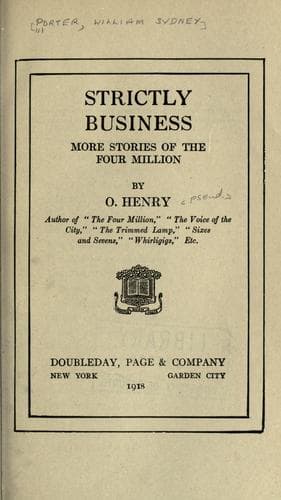
Strictly Business: More Stories of the Four MillionHenry, O.
Philosophy
Strictly Business: More Stories of the Four Million
Henry, O.
New York (N.Y.) -- Social life and customs -- Fiction
From the first Helen felt a marvelous and compelling thrill in the
presence of this man. His voice somehow took her swiftly back to the
days of her youth’s romance. This feeling grew, and she gave way to it,
and it led her to an instinctive belief that he had been a factor in
that romance. And then with a woman’s reasoning (oh, yes, they do,
sometimes) she leaped over common syllogisms and theory, and logic, and
was sure that her husband had come back to her. For she saw in his eyes
love, which no woman can mistake, and a thousand tons of regret and
remorse, which aroused pity, which is perilously near to love requited,
which is the _sine qua non_ in the house that Jack built.
But she made no sign. A husband who steps around the corner for twenty
years and then drops in again should not expect to find his slippers
laid out too conveniently near nor a match ready lighted for his cigar.
There must be expiation, explanation, and possibly execration. A little
purgatory, and then, maybe, if he were properly humble, he might be
trusted with a harp and crown. And so she made no sign that she knew or
suspected.
And my friend, the reporter, could see nothing funny in this! Sent out
on an assignment to write up a roaring, hilarious, brilliant joshing
story of—but I will not knock a brother—let us go on with the story.
One evening Ramonti stopped in Helen’s hall-office-reception-room and
told his love with the tenderness and ardor of the enraptured artist.
His words were a bright flame of the divine fire that glows in the
heart of a man who is a dreamer and doer combined.
“But before you give me an answer,” he went on, before she could accuse
him of suddenness, “I must tell you that ‘Ramonti?’ is the only name I
have to offer you. My manager gave me that. I do not know who I am or
where I came from. My first recollection is of opening my eyes in a
hospital. I was a young man, and I had been there for weeks. My life
before that is a blank to me. They told me that I was found lying in
the street with a wound on my head and was brought there in an
ambulance. They thought I must have fallen and struck my head upon the
stones. There was nothing to show who I was. I have never been able to
remember. After I was discharged from the hospital, I took up the
violin. I have had success. Mrs. Barry—I do not know your name except
that—I love you; the first time I saw you I realized that you were the
one woman in the world for me—and”—oh, a lot of stuff like that.
Helen felt young again. First a wave of pride and a sweet little thrill
of vanity went all over her; and then she looked Ramonti in the eyes,
and a tremendous throb went through her heart. She hadn’t expected that
throb. It took her by surprise. The musician had become a big factor in
her life, and she hadn’t been aware of it.
“Mr. Ramonti,” she said sorrowfully (this was not on the stage,
remember; it was in the old home near Abingdon Square), “I’m awfully
sorry, but I’m a married woman.”
Public-domain text, read in full here on John Shaqi.
Reviews
Reviews
No reviews yet
Be the first to share your thoughts on this work.
Elsewhere in the archive
Join the Discussion
Join the discussion
Sign in to leave a comment or review.
Sign InorCreate an account