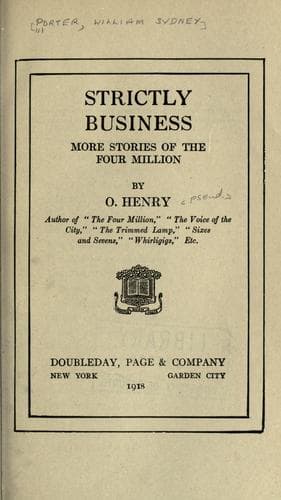
Strictly Business: More Stories of the Four MillionHenry, O.
Philosophy
Strictly Business: More Stories of the Four Million
Henry, O.
New York (N.Y.) -- Social life and customs -- Fiction
And then she told him the sad story of her life, as a heroine must do,
sooner or later, either to a theatrical manager or to a reporter.
Ramonti took her hand, bowed low and kissed it, and went up to his
room.
Helen sat down and looked mournfully at her hand. Well she might. Three
suitors had kissed it, mounted their red roan steeds and ridden away.
In an hour entered the mysterious stranger with the haunting eyes.
Helen was in the willow rocker, knitting a useless thing in
cotton-wool. He ricocheted from the stairs and stopped for a chat.
Sitting across the table from her, he also poured out his narrative of
love. And then he said: “Helen, do you not remember me? I think I have
seen it in your eyes. Can you forgive the past and remember the love
that has lasted for twenty years? I wronged you deeply—I was afraid to
come back to you—but my love overpowered my reason. Can you, will you,
forgive me?”
Helen stood up. The mysterious stranger held one of her hands in a
strong and trembling clasp.
There she stood, and I pity the stage that it has not acquired a scene
like that and her emotions to portray.
For she stood with a divided heart. The fresh, unforgettable, virginal
love for her bridegroom was hers; the treasured, sacred, honored memory
of her first choice filled half her soul. She leaned to that pure
feeling. Honor and faith and sweet, abiding romance bound her to it.
But the other half of her heart and soul was filled with something
else—a later, fuller, nearer influence. And so the old fought against
the new.
And while she hesitated, from the room above came the soft, racking,
petitionary music of a violin. The hag, music, bewitches some of the
noblest. The daws may peck upon one’s sleeve without injury, but
whoever wears his heart upon his tympanum gets it not far from the
neck.
This music and the musician called her, and at her side honor and the
old love held her back.
“Forgive me,” he pleaded.
“Twenty years is a long time to remain away from the one you say you
love,” she declared, with a purgatorial touch.
“How could I tell?” he begged. “I will conceal nothing from you. That
night when he left I followed him. I was mad with jealousy. On a dark
street I struck him down. He did not rise. I examined him. His head had
struck a stone. I did not intend to kill him. I was mad with love and
jealousy. I hid near by and saw an ambulance take him away. Although
you married him, Helen—”
“_Who Are You?_” cried the woman, with wide-open eyes, snatching her
hand away.
“Don’t you remember me, Helen—the one who has always loved you best? I
am John Delaney. If you can forgive—”
But she was gone, leaping, stumbling, hurrying, flying up the stairs
toward the music and him who had forgotten, but who had known her for
his in each of his two existences, and as she climbed up she sobbed,
cried and sang: “Frank! Frank! Frank!”
Public-domain text, read in full here on John Shaqi.
Reviews
Reviews
No reviews yet
Be the first to share your thoughts on this work.
Elsewhere in the archive
Join the Discussion
Join the discussion
Sign in to leave a comment or review.
Sign InorCreate an account