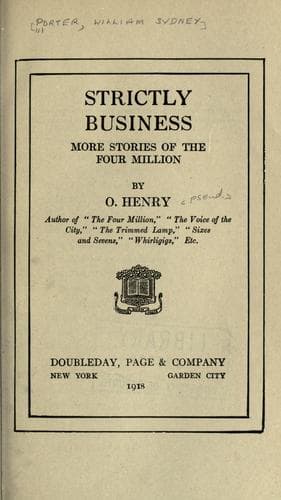
Strictly Business: More Stories of the Four MillionHenry, O.
Philosophy
Strictly Business: More Stories of the Four Million
Henry, O.
New York (N.Y.) -- Social life and customs -- Fiction
“It is only a case of insufficient nutrition,” he said. “In other
words, the result of poverty, pride, and starvation. Mrs. Caswell has
many devoted friends who would be glad to aid her, but she will accept
nothing except from that old Negro, Uncle Cæsar, who was once owned by
her family.”
“Mrs. Caswell!” said I, in surprise. And then I looked at the contract
and saw that she had signed it “Azalea Adair Caswell.”
“I thought she was Miss Adair,” I said.
“Married to a drunken, worthless loafer, sir,” said the doctor. “It is
said that he robs her even of the small sums that her old servant
contributes toward her support.”
When the milk and wine had been brought the doctor soon revived Azalea
Adair. She sat up and talked of the beauty of the autumn leaves that
were then in season, and their height of color. She referred lightly to
her fainting seizure as the outcome of an old palpitation of the heart.
Impy fanned her as she lay on the sofa. The doctor was due elsewhere,
and I followed him to the door. I told him that it was within my power
and intentions to make a reasonable advance of money to Azalea Adair on
future contributions to the magazine, and he seemed pleased.
“By the way,” he said, “perhaps you would like to know that you have
had royalty for a coachman. Old Cæsar’s grandfather was a king in
Congo. Cæsar himself has royal ways, as you may have observed.”
As the doctor was moving off I heard Uncle Cæsar’s voice inside: “Did
he get bofe of dem two dollars from you, Mis’ Zalea?”
“Yes, Cæsar,” I heard Azalea Adair answer weakly. And then I went in
and concluded business negotiations with our contributor. I assumed the
responsibility of advancing fifty dollars, putting it as a necessary
formality in binding our bargain. And then Uncle Cæsar drove me back to
the hotel.
Here ends all of the story as far as I can testify as a witness. The
rest must be only bare statements of facts.
At about six o’clock I went out for a stroll. Uncle Cæsar was at his
corner. He threw open the door of his carriage, flourished his duster
and began his depressing formula: “Step right in, suh. Fifty cents to
anywhere in the city—hack’s puffickly clean, suh—jus’ got back from a
funeral—”
And then he recognized me. I think his eyesight was getting bad. His
coat had taken on a few more faded shades of color, the twine strings
were more frayed and ragged, the last remaining button—the button of
yellow horn—was gone. A motley descendant of kings was Uncle Cæsar!
About two hours later I saw an excited crowd besieging the front of a
drug store. In a desert where nothing happens this was manna; so I
wedged my way inside. On an extemporized couch of empty boxes and
chairs was stretched the mortal corporeality of Major Wentworth
Caswell. A doctor was testing him for the immortal ingredient. His
decision was that it was conspicuous by its absence.
Public-domain text, read in full here on John Shaqi.
Reviews
Reviews
No reviews yet
Be the first to share your thoughts on this work.
Elsewhere in the archive
Join the Discussion
Join the discussion
Sign in to leave a comment or review.
Sign InorCreate an account