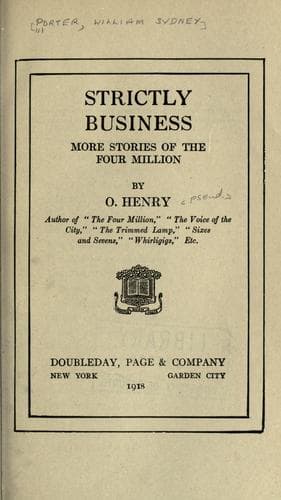
Strictly Business: More Stories of the Four MillionHenry, O.
Philosophy
Strictly Business: More Stories of the Four Million
Henry, O.
New York (N.Y.) -- Social life and customs -- Fiction
From this high view the city itself becomes degraded to an
unintelligible mass of distorted buildings and impossible perspectives;
the revered ocean is a duck pond; the earth itself a lost golf ball.
All the minutiae of life are gone. The philosopher gazes into the
infinite heavens above him, and allows his soul to expand to the
influence of his new view. He feels that he is the heir to Eternity and
the child of Time. Space, too, should be his by the right of his
immortal heritage, and he thrills at the thought that some day his kind
shall traverse those mysterious aerial roads between planet and planet.
The tiny world beneath his feet upon which this towering structure of
steel rests as a speck of dust upon a Himalayan mountain—it is but one
of a countless number of such whirling atoms. What are the ambitions,
the achievements, the paltry conquests and loves of those restless
black insects below compared with the serene and awful immensity of the
universe that lies above and around their insignificant city?
It is guaranteed that the philosopher will have these thoughts. They
have been expressly compiled from the philosophies of the world and set
down with the proper interrogation point at the end of them to
represent the invariable musings of deep thinkers on high places. And
when the philosopher takes the elevator down his mind is broader, his
heart is at peace, and his conception of the cosmogony of creation is
as wide as the buckle of Orion’s summer belt.
But if your name happened to be Daisy, and you worked in an Eighth
Avenue candy store and lived in a little cold hall bedroom, five feet
by eight, and earned $6 per week, and ate ten-cent lunches and were
nineteen years old, and got up at 6.30 and worked till 9, and never had
studied philosophy, maybe things wouldn’t look that way to you from the
top of a skyscraper.
Two sighed for the hand of Daisy, the unphilosophical. One was Joe, who
kept the smallest store in New York. It was about the size of a
tool-box of the D. P. W., and was stuck like a swallow’s nest against a
corner of a down-town skyscraper. Its stock consisted of fruit,
candies, newspapers, song books, cigarettes, and lemonade in season.
When stern winter shook his congealed locks and Joe had to move himself
and the fruit inside, there was exactly room in the store for the
proprietor, his wares, a stove the size of a vinegar cruet, and one
customer.
Joe was not of the nation that keeps us forever in a furore with fugues
and fruit. He was a capable American youth who was laying by money, and
wanted Daisy to help him spend it. Three times he had asked her.
“I got money saved up, Daisy,” was his love song; “and you know how bad
I want you. That store of mine ain’t very big, but—”
“Oh, ain’t it?” would be the antiphony of the unphilosophical one.
“Why, I heard Wanamaker’s was trying to get you to sublet part of your
floor space to them for next year.”
Daisy passed Joe’s corner every morning and evening.
Public-domain text, read in full here on John Shaqi.
Reviews
Reviews
No reviews yet
Be the first to share your thoughts on this work.
Elsewhere in the archive
Join the Discussion
Join the discussion
Sign in to leave a comment or review.
Sign InorCreate an account