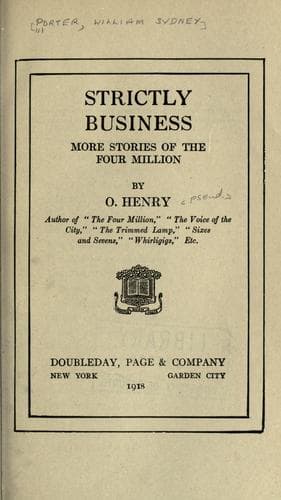
Strictly Business: More Stories of the Four MillionHenry, O.
Philosophy
Strictly Business: More Stories of the Four Million
Henry, O.
New York (N.Y.) -- Social life and customs -- Fiction
He showed her the great city lying like an orderly array of toys far
below, starred here and there, early as it was, by the first beacon
lights of the winter afternoon. And then the bay and sea to the south
and east vanishing mysteriously into the sky.
“I don’t like it,” declared Daisy, with troubled blue eyes. “Say we go
down.”
But the philosopher was not to be denied his opportunity. He would let
her behold the grandeur of his mind, the half-nelson he had on the
infinite, and the memory he had for statistics. And then she would
nevermore be content to buy chewing gum at the smallest store in New
York. And so he began to prate of the smallness of human affairs, and
how that even so slight a removal from earth made man and his works
look like one tenth part of a dollar thrice computed. And that one
should consider the sidereal system and the maxims of Epictetus and be
comforted.
“You don’t carry me with you,” said Daisy. “Say, I think it’s awful to
be up so high that folks look like fleas. One of them we saw might have
been Joe. Why, Jiminy! we might as well be in New Jersey! Say, I’m
afraid up here!”
The philosopher smiled fatuously.
“The earth,” said he, “is itself only as a grain of wheat in space.
Look up there.”
Daisy gazed upward apprehensively. The short day was spent and the
stars were coming out above.
“Yonder star,” said Dabster, “is Venus, the evening star. She is
66,000,000 miles from the sun.”
“Fudge!” said Daisy, with a brief flash of spirit, “where do you think
I come from—Brooklyn? Susie Price, in our store—her brother sent her a
ticket to go to San Francisco—that’s only three thousand miles.”
The philosopher smiled indulgently.
“Our world,” he said, “is 91,000,000 miles from the sun. There are
eighteen stars of the first magnitude that are 211,000 times further
from us than the sun is. If one of them should be extinguished it would
be three years before we would see its light go out. There are six
thousand stars of the sixth magnitude. It takes thirty-six years for
the light of one of them to reach the earth. With an eighteen-foot
telescope we can see 43,000,000 stars, including those of the
thirteenth magnitude, whose light takes 2,700 years to reach us. Each
of these stars—”
“You’re lyin’,” cried Daisy, angrily. “You’re tryin’ to scare me. And
you have; I want to go down!”
She stamped her foot.
“Arcturus—” began the philosopher, soothingly, but he was interrupted
by a demonstration out of the vastness of the nature that he was
endeavoring to portray with his memory instead of his heart. For to the
heart-expounder of nature the stars were set in the firmament expressly
to give soft light to lovers wandering happily beneath them; and if you
stand tiptoe some September night with your sweetheart on your arm you
can almost touch them with your hand. Three years for their light to
reach us, indeed!
Public-domain text, read in full here on John Shaqi.
Reviews
Reviews
No reviews yet
Be the first to share your thoughts on this work.
Elsewhere in the archive
Join the Discussion
Join the discussion
Sign in to leave a comment or review.
Sign InorCreate an account