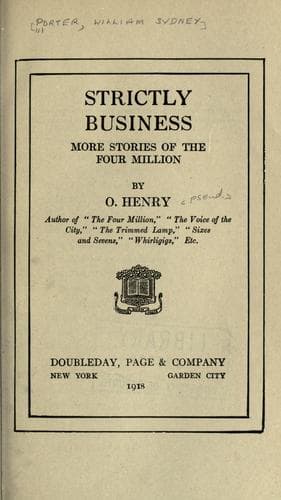
Strictly Business: More Stories of the Four MillionHenry, O.
Philosophy
Strictly Business: More Stories of the Four Million
Henry, O.
New York (N.Y.) -- Social life and customs -- Fiction
The great city of Bagdad-on-the-Subway is caliph-ridden. Its palaces,
bazaars, khans, and byways are thronged with Al Rashids in divers
disguises, seeking diversion and victims for their unbridled
generosity. You can scarcely find a poor beggar whom they are willing
to let enjoy his spoils unsuccored, nor a wrecked unfortunate upon whom
they will not reshower the means of fresh misfortune. You will hardly
find anywhere a hungry one who has not had the opportunity to tighten
his belt in gift libraries, nor a poor pundit who has not blushed at
the holiday basket of celery-crowned turkey forced resoundingly through
his door by the eleemosynary press.
So then, fearfully through the Harun-haunted streets creep the one-eyed
calenders, the Little Hunchback and the Barber’s Sixth Brother, hoping
to escape the ministrations of the roving horde of caliphoid sultans.
Entertainment for many Arabian nights might be had from the histories
of those who have escaped the largesse of the army of Commanders of the
Faithful. Until dawn you might sit on the enchanted rug and listen to
such stories as are told of the powerful genie Roc-Ef-El-Er who sent
the Forty Thieves to soak up the oil plant of Ali Baba; of the good
Caliph Kar-Neg-Ghe, who gave away palaces; of the Seven Voyages of
Sailbad, the Sinner, who frequented wooden excursion steamers among the
islands; of the Fisherman and the Bottle; of the Barmecides’ Boarding
house; of Aladdin’s rise to wealth by means of his Wonderful Gas-meter.
But now, there being ten sultans to one Sheherazade, she is held too
valuable to be in fear of the bowstring. In consequence the art of
narrative languishes. And, as the lesser caliphs are hunting the happy
poor and the resigned unfortunate from cover to cover in order to heap
upon them strange mercies and mysterious benefits, too often comes the
report from Arabian headquarters that the captive refused “to talk.”
This reticence, then, in the actors who perform the sad comedies of
their philanthropy-scourged world, must, in a degree, account for the
shortcomings of this painfully gleaned tale, which shall be called
THE STORY OF THE CALIPH WHO ALLEVIATED HIS CONSCIENCE
Old Jacob Spraggins mixed for himself some Scotch and lithia water at
his $1,200 oak sideboard. Inspiration must have resulted from its
imbibition, for immediately afterward he struck the quartered oak
soundly with his fist and shouted to the empty dining room:
“By the coke ovens of hell, it must be that ten thousand dollars! If I
can get that squared, it’ll do the trick.”
Thus, by the commonest artifice of the trade, having gained your
interest, the action of the story will now be suspended, leaving you
grumpily to consider a sort of dull biography beginning fifteen years
before.
Public-domain text, read in full here on John Shaqi.
Reviews
Reviews
No reviews yet
Be the first to share your thoughts on this work.
Elsewhere in the archive
Join the Discussion
Join the discussion
Sign in to leave a comment or review.
Sign InorCreate an account