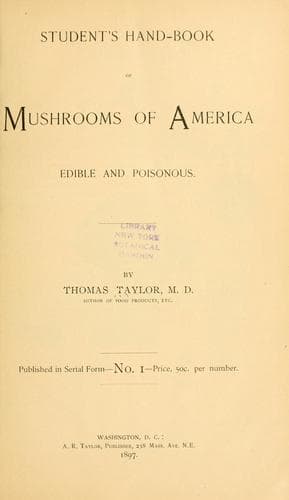
Student's Hand-book of Mushrooms of America, Edible and PoisonousTaylor, Thomas
Science
Student's Hand-book of Mushrooms of America, Edible and Poisonous
Taylor, Thomas
Mushrooms -- United States; Pathogenic fungi
Cap at first convex, afterwards well expanded; _smooth_, free from
warts, striate on the margin; color orange-red or bright lemon-yellow,
with red disk; gills lemon-yellow, rounded near the stem, and free from
it; stem equal or slightly tapering upwards, stuffed with cottony
fibrils, or hollow (color clear lemon-yellow), bearing a yellowish ring
near the top and sheathed at the base with large, loose, membranous,
white volva. Odor faint but agreeable. Spores white, elliptical.
The whole plant is symmetrical in form, brilliant in coloring, clean and
attractive in appearance. The American plant seems to differ in some
slight respects from the European as figured and described in European
works. In Europe the pileus or cap is said to vary in color, being
sometimes white, pale yellow, red or even copper color, although it is
usually orange-yellow. My own observation of the American plant of this
species agrees with that of Prof. Peck in that the cap is uniform in
color, being at first bright reddish-orange or even brilliant red,
fading with age to yellow, either wholly or only on the margin. No white
specimens have been as yet recorded in this country. The red color
disappears in the dried specimens. The striations of the margin are
usually quite deep and long and almost as distant as in the edible
species Amanitopsis _vaginata_. Some European writers have described the
flesh or substance of the cap as yellowish. In our plant the flesh is
white, but stained with yellow or red immediately under the cuticle.
Amanita _Caesarea_ is the only one of the Amanitas which has yellow
gills.
Berkeley, in his "Outlines of British Fungi," describes A. Caesarea as it
is found in some parts of Continental Europe, but states that up to the
date of his writing it had not been found in Great Britain. It is not
recorded in the more recent lists of British fungi by M. C. Cooke nor in
that of Australian fungi by the same author. The species has a wide
range in this country, and though not very common in the North, in some
localities, as in the pine and oak woods of North Carolina, it is found
in great abundance. Dufour states that it is much esteemed as an
esculent in France, and though rare in the northern part of that
country, it is common in the center and the south of France in autumn.
It is well known in different portions of Continental Europe, and is
frequently figured in contrast with its very poisonous congener, Amanita
muscaria, or "False Orange," commonly known as the "Fly Amanita," or
"Fly-Killer."
A careless observer might mistake one for the other, but with a little
attention to well-defined details the edible form can be readily
distinguished from the poisonous one.
Public-domain text, read in full here on John Shaqi.
Reviews
Reviews
No reviews yet
Be the first to share your thoughts on this work.
Elsewhere in the archive
Join the Discussion
Join the discussion
Sign in to leave a comment or review.
Sign InorCreate an account