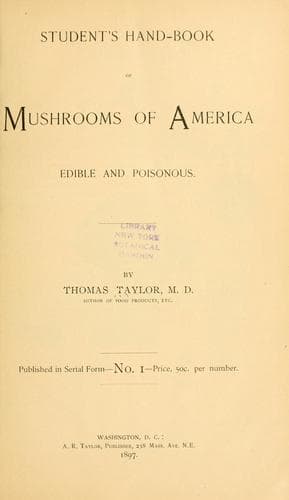
Student's Hand-book of Mushrooms of America, Edible and PoisonousTaylor, Thomas
Science
Student's Hand-book of Mushrooms of America, Edible and Poisonous
Taylor, Thomas
Mushrooms -- United States; Pathogenic fungi
This mushroom is very pleasant to the taste when raw as well as when
cooked. It is found in light woods or on the borders of woods where the
soil is somewhat friable, generally solitary, but sometimes two or three
are found clustered together. The plants are sometimes so large that two
or three of them would make a very good meal. Specimens have been found
with the cap measuring 8 to 9 inches across when expanded, the stem
varying from 6 to 8 inches in height, and from 1 to 3 inches in
thickness. When young the plants are generally snowy white throughout,
changing with age to a dingy white or cinereous hue. The specimens
figured in the plate formed one of a cluster of three mushrooms of this
species found growing in the fir woods of the District of Columbia.
During some seasons I have found the _strobiliformis_, or "Fir-cone
mushroom," fairly plentiful in some parts of Maryland, and in other
seasons it has been rare. The whole plant when young is enclosed in a
white membranous wrapper.
Although this species is very generally recognized by mycologists as
edible, I would advise great caution in selecting specimens for table
use, since there is a dangerous species which might be mistaken for it
by one not familiar with the characteristics of both species; I refer to
a form of Amanita muscaria with ochraceous yellow cap which, when faded
or bleached by the sun and rain, sometimes approaches, in tint, the
dingy white of old or faded specimens of the _strobiliformis_. Both
species have _white gills_, _white stems_, and _white flocculent veil_.
The volva is evanescent in both, leaving traces of its existence in
concentric ridges at the base, and part way up the stem.
In the species _strobiliformis_, the flesh of the cap is white
throughout, as well as the cuticle.
In the yellowish _muscaria_, the flesh _immediately_ beneath the cuticle
of the upper surface of the cap is yellowish, frequently deepening at
the disk to orange hue.
The cap of Amanita _muscaria_ is very attractive to flies, but proves
to them, as also to roaches and to some other insects, a deadly poison.
The juice of _strobiliformis_ is not poisonous to flies. This fact may
aid in identifying the species.
Subgenus _Amanitopsis_ Roze. The species of this subgenus were formerly
included in Amanita. The characteristic which separates it from Amanita
is the _absence of a ring on the stem_. The gills are free from the
stem, the spores are white, and the whole plant in youth is encased in
an egg-shaped volva.[A]
[A] Although this subgenus is not included in M. C. Cooke's analytical
key to the order of Agaricini, published with his kind permission in No.
3 of this series, he now includes it as one of the subgenera which
should have a place in that list.
Amanitopsis _vaginata_ Roze. Edible.
Public-domain text, read in full here on John Shaqi.
Reviews
Reviews
No reviews yet
Be the first to share your thoughts on this work.
Elsewhere in the archive
Join the Discussion
Join the discussion
Sign in to leave a comment or review.
Sign InorCreate an account