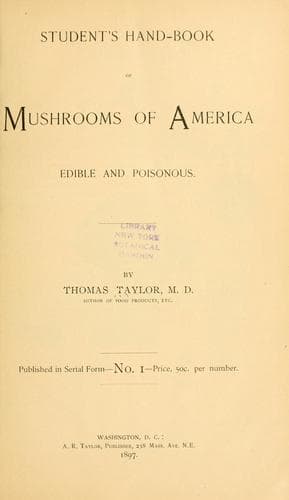
Student's Hand-book of Mushrooms of America, Edible and PoisonousTaylor, Thomas
Science
Student's Hand-book of Mushrooms of America, Edible and Poisonous
Taylor, Thomas
Mushrooms -- United States; Pathogenic fungi
Russula (Fragiles) _emetica_ Fries. Cap fleshy, at first convex, then
expanded or depressed, smooth, polished, red, margin sulcate; gills
free, equal and broad, white; stem solid but somewhat spongy in the
center, smooth, short, stoutish, white or stained reddish; flesh white,
sometimes slightly tinted red, under the thin red cuticle. The cap of
this mushroom varies from a deep rich crimson to a pale pinkish red,
being very subject to atmospheric changes. Specimens are often found
with the cap washed almost white after heavy rains, or with but a slight
red spot in the center. The gills and spores are pure white, and the
flesh peppery to the taste. If tasted when raw the juice should not be
swallowed.
The variety _Clusii_ has a blood-red cap, pallid yellowish gills,
adnexed, becoming adnate. Spores white. In woods. Acrid. The variety
_fallax_ is fragile, with dingy reddish pileus and adnexed, distant,
whitish gills.
Besides the above mentioned, there are other acrid Russulas and Lactars
which are regarded with suspicion, though not as yet satisfactorily
tested.
POISONOUS BOLETI.
Several of the Boleti have the reputation of being poisonous or
deleterious, among them Boletus _luridus_, Boletus _Satanas_, and
Boletus _felleus._ Kobert's analysis of B. _luridus_ shows the presence
of the poisonous alkaloid muscarin in this mushroom, while the
bitterness of B. _felleus_ should make one chary of eating it in
quantity, if at all. Schmiedeberg and Koppe describe experiments made
with Boletus Satanas, in which the symptoms experienced closely resemble
those of muscarin poisoning.
A correspondent living in Georgia, who is quite familiar with the
species, writes that he has frequently eaten the yellow form of the
_muscaria_, when cooked, without serious inconvenience. Another
correspondent writes that he has eaten the species Boletus luridus and
Boletus Satanas, as well as several other mushrooms of poisonous repute,
with perfect impunity.
Without calling in question the testimony of persons who state that they
have with impunity eaten mushrooms generally found to be poisonous, it
must be said that even if, through local conditions of soil or climate,
the poisonous constituents of such mushrooms sometimes exist in
comparatively minute proportions, or are _neutralized_ by an unusual
proportion of _mushroom atropin_ in the plant, or eliminated by some
process used in its preparation for the table, or, finally, if
constitutional idiosyncrasies should enable some persons safely to eat
what is poisonous to others, the rule that such are to be avoided should
never be disregarded by the ordinary collector, nor should it be
departed from even by experts, except upon the clearest evidence that in
the given case the departure is safe. It is certainly the part of
discretion, when in doubt, to take no risks.
RECENT INSTANCES OF MUSHROOM POISONING.
Public-domain text, read in full here on John Shaqi.
Reviews
Reviews
No reviews yet
Be the first to share your thoughts on this work.
Elsewhere in the archive
Join the Discussion
Join the discussion
Sign in to leave a comment or review.
Sign InorCreate an account