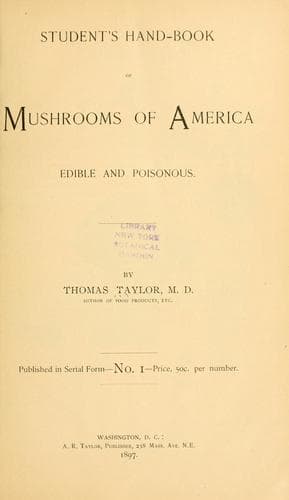
Student's Hand-book of Mushrooms of America, Edible and Poisonous — John Shaqi
Student's Hand-book of Mushrooms of America, Edible and PoisonousTaylor, Thomas
Science
Student's Hand-book of Mushrooms of America, Edible and Poisonous
Taylor, Thomas
Mushrooms -- United States; Pathogenic fungi
For commercial purposes the English method of making the spawn into
bricks has some advantages over the French "flake" process. Its compact
and uniform shape makes the brick more convenient for storage and
general handling, and greatly facilitates its transportation to long
distances. Brick spawn is made in the following manner: Clean horse
droppings, cow manure, loam, and road sweepings are beaten up in a
mortar-like consistency and then formed into bricks, moulds being used,
slightly differing in shape with different makers, but usually thinner
and wider than common building bricks. The following proportions are
given: (1) Horse droppings the chief part; one-fourth cow dung;
remainder loam. (2) Fresh horse droppings mixed with short litter for
the greater part; cow dung, one third; and the rest mould or loam. (3)
Horse dung, cow dung, and loam, in equal parts. When about half dry,
depressions are made in the bricks, sometimes in the centre, and
sometimes in each corner, and small pieces of good spawn are placed in
these depressions, and plastered over with the material of the brick.
The cakes are then laid out to dry, standing on their edges, and when
nearly dry are piled in pairs with the spawn-larded surfaces face to
face. The bricks are then stacked away, and covered with sweet
fermenting litter, sufficiently to cause a heat of 60 F. It should not
be over 70 F. One spawn manufacturer says that the most rapid and
successful growth of the mycelium is attained when the temperature is
from 63 F. to 67 F. The bricks are examined frequently during the
process, and when the mycelium of the old spawn has permeated the whole
mass like a fine white mould, the bricks are taken out and dried in a
well-ventilated dark place. They are then placed in a cool, dark
storehouse, where they are not subject to dampness and where the
temperature is about 50 F., not over 65 or below 35 F. Slight
ventilation is necessary, but not enough to make the bricks dust-dry.
Keeping the spawn dry merely suspends its growth; as soon as it is again
submitted to favorable conditions of moisture and heat, its pristine
activity returns. Dampness, combined with heat, stimulates the growth of
mycelium; frost also destroys the vitality of the spawn. It is evident,
therefore, that these conditions should not exist in the store-room.
One manufacturer advocates piling the bricks, after spawning, on a clay
floor, packing closely four bricks deep, and covering them with sifted
loam. By this method it is claimed that danger of "fire fang" will be
avoided, as the bricks will be kept at a perfectly uniform temperature
of about 60 or 66, which causes the spawn to run quickly and
uniformly. In from four to six weeks they are ready to take out and dry
for use or storage.
Public-domain text, read in full here on John Shaqi.
Reviews
Reviews
No reviews yet
Be the first to share your thoughts on this work.
Join the Discussion
Join the discussion
Sign in to leave a comment or review.
Sign InorCreate an account