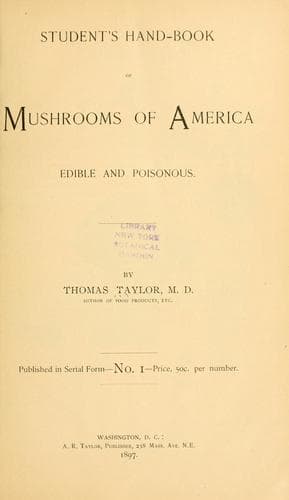
Student's Hand-book of Mushrooms of America, Edible and PoisonousTaylor, Thomas
Science
Student's Hand-book of Mushrooms of America, Edible and Poisonous
Taylor, Thomas
Mushrooms -- United States; Pathogenic fungi
Hymenophore confluent _Galera_
IV. Spores purple, sometimes brownish purple, dark purple,
or dark brown.--Pratellae.
36. Without cartilaginous bark.
37. Hymenophore free.
38. With a volva _Chitonia_
38. Without a volva _Psalliota_
37. Hymenophore confluent.
39. Veil normally ring shaped on the stem _Stropharia_
39. Veil normally adhering to the margin of
the pileus _Hypholoma_
36. With cartilaginous bark.
40. Gills decurrent _Deconica_
40. Gills not decurrent.
41. Margin of pileus at first incurved _Psilocybe_
41. Margin of pileus at first straight _Psathyra_
V. Spores black or nearly so.--Coprinarii.
42. Gills deliquescent COPRINUS
42. Gills not deliquescent.
43. Gills decurrent GOMPHIDIUS
43. Gills not decurrent.
44. Pileus striate _Psathyrella_
44. Pileus not striate _Panaeolus_
In the Friesian classification which, with modifications, has prevailed
for many years among mycologists, the _genus Agaricus_ included in its
_subgenera_ the greater part of the species of the order _Agaricini_.
The subgenera, printed in the above table in italics, were included in
this genus. The genera are printed in capitals. In the Saccardian
system, all the _subgenera_ of _Agaricus_ having been elevated to
_generic_ rank, the term Agaricus is limited to a very small group which
includes the _subgenus Psalliota_ of Fries, the species being
characterized by fleshy caps, free gills, ringed stem, and dark brown or
purplish brown spores. As restricted, it naturally falls into the spore
series _Melanosporeae._
In the white-spored section, Leucospori, the recorded edible species
occur in the following genera: Marasmius, Cantharellus, Lactarius,
Russula, Hygrophorus, Collybia, Pleurotus, Clitocybe, Tricholoma,
Armillaria, Lepiota, and Amanita. The plants of Marasmius are usually
thin and dry, reviving with moisture. Cantharellus is characterized by
the obtuseness of the edges of the lamellae, Lactarius by the copious
milky or sticky fluid which exudes from the plants when cut or bruised.
Russula is closely allied to Lactarius, and the plants bear some
resemblance in external appearance to those of that genus, but they are
never milky, and the gills are usually rigid and brittle. In Hygrophorus
the plants are moist, not very large, often bright colored, and the
gills have a waxy appearance. The Collybias are usually caespitose, the
stems exteriorly cartilaginous, in some species swelling and splitting
open in the centre.
Public-domain text, read in full here on John Shaqi.
Reviews
Reviews
No reviews yet
Be the first to share your thoughts on this work.
Elsewhere in the archive
Join the Discussion
Join the discussion
Sign in to leave a comment or review.
Sign InorCreate an account