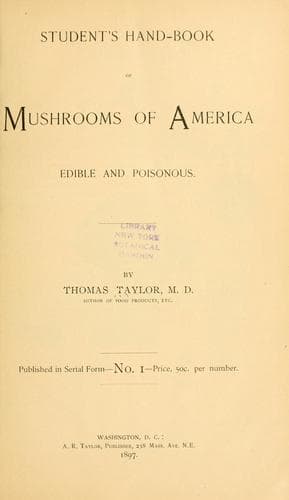
Student's Hand-book of Mushrooms of America, Edible and PoisonousTaylor, Thomas
Science
Student's Hand-book of Mushrooms of America, Edible and Poisonous
Taylor, Thomas
Mushrooms -- United States; Pathogenic fungi
In Pleurotus the stem is lateral or absent. The plants are epiphytal,
usually springing from the decaying bark of trees and old stumps.
In Clitocybe the plants are characterized by a deeply depressed, often
narrow cap, with the gills acutely adnate, or running far down the stem,
which is elastic, with a fibrous outer coat covered with minute fibers.
Many of the species have a fragrant odor. The Tricholomas are stout and
fleshy, somewhat resembling the Russulas, but distinguished from them by
the sinuate character of the gills, which show a slight notched or
toothed depression just before reaching the stem (represented in Fig. 4,
Plate IV). Typical species of Armillaria show a well-defined ring and
scales upon the stem, the remains of the partial veil, and the plants
are usually large, and caespitose. The Lepiotas are recognized by the
soft, thready character of the fleshy portion of the cap, and the
fringed scales formed by the breaking of the cuticle. The ease with
which the ringed stem is removed from its socket in the cap is another
characteristic which distinguishes the plants from those of other
genera.
The Amanitas are distinguished by the volva, which sheathes the somewhat
bulbous stem at its base and the ring and veil which in the young plant
are very distinct features, the whole plant in embryo being enveloped in
the volva.
The Amanita group, besides containing some very good edible species, is
also credited with containing the most dangerous species of all the
mushroom family, and some which are undoubtedly fatal in their
effects.[A]
[A] A more detailed description of this group will appear in No. 5 of
this series.
The Nyctali are minute mushrooms parasitic on other mushrooms.
In Omphalia, the plants are quite small, with membranaceous caps, gills
truly decurrent, and cartilaginous stems.
The Myceneae are generally very small, slender, and fragile, usually
caespitose, with bell-shaped caps, sinuate gills, not decurrent, and
cartilaginous stems. In some species the plants exude a milky juice.
In the genera Panus, Lentinus, Lenzites, Schizophyllum, Xerotus, and
Trogia, the plants are leathery or coriaceous, dry and tough, and though
none are recorded as poisonous, they are too tough to be edible.
The mushrooms having pink or salmon colored spores, section Rhodosporii,
form the smallest of the four primary groups of Agaricini, the number of
known species not exceeding 400, and most of these are tasteless, or of
disagreeable odor, while some are recorded as unwholesome.
The species are pink-gilled when mature, though often white or whitish
when very young.
Public-domain text, read in full here on John Shaqi.
Reviews
Reviews
No reviews yet
Be the first to share your thoughts on this work.
Elsewhere in the archive
Join the Discussion
Join the discussion
Sign in to leave a comment or review.
Sign InorCreate an account