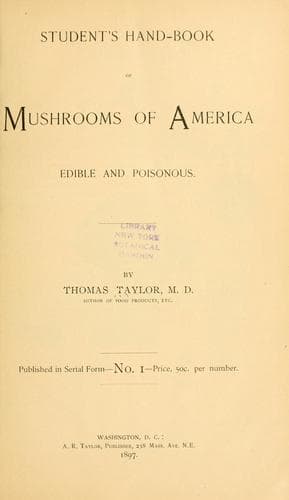
Student's Hand-book of Mushrooms of America, Edible and PoisonousTaylor, Thomas
Science
Student's Hand-book of Mushrooms of America, Edible and Poisonous
Taylor, Thomas
Mushrooms -- United States; Pathogenic fungi
A number of groups, each of which was treated in the original Friesian
classification as a single genus, have more recently been recognized as
comprising several distinct genera. In the Saccardian system the genera
Trametes, Daedalea, Merulius, Porothelium, and Fistulina still retain the
generic rank assigned to them by Fries, but the old genus Boletus is
subdivided into four genera, Boletus, Strobilomyces, Boletinus, and
Gyrodon, while Polyporus, originally a very large genus, is subdivided
into the genera Polyporus, Fomes, Polystictus, and Poria. This
arrangement was in part suggested by Fries in his later works, and is
accepted by M. C. Cooke, as indicated in his latest work on fungi.
Quoting M. C. Cooke, "_Strobilomyces_ is _Boletus_ with a rough warty
and scaly pileus; _Boletinus_ is _Boletus_ with short, large radiating
pores; and _Gyrodon_ is _Boletus_ with elongated sinuate irregular
pores, all fleshy, firm fungi of robust habit, possessing stem and cap."
The species of the genus Polyporus as now restricted are somewhat fleshy
in the young stage, shrinking as they mature and dry, and becoming
indurated with age. In Fomes the species, of woody consistency from the
first, have no room for shrinkage, and are quite rigid; the tubes being
in strata, and the strata growing yearly, the species are virtually
perennial. The pileus of the plant shows a rigid polished crust
resulting from resinous exudations.
In Polystictus the plants are usually small, thin, tough, and irregular
in outline, the tubes exceedingly short, with thin walls, which easily
split up, giving the pores at times a toothed or fringed appearance. The
surface is velvety, or hairy, and zoned in varying colors. They are very
common upon decaying tree stumps, often covering the surface of the
stump in gaily colored layers. Not esculent.
Poria is composed of resupinate species with the pores normally in a
single series, the whole stratum spread over, and adhering to the
matrix. The species are coriaceous or woody. Not esculent.
The plants of the genus Trametes allied to Fomes are epiphytal, with the
trama the same in substance and color as the hymenophore. The tubes do
not form in regular strata, but are sunk into the substance of the
pileus. The plants are coriaceous, and none are edible.
Daedalea closely resembles _Trametes_ with the tubes forming deep
labyrinthiform depressions. Whole plant woody, sessile.
Hexagonia, allied by its characteristics to Polystictus, has large
hexagonal pores, with firm, entire dissepiments.
In Favolus the plants are slightly fleshy and substipitate with the
pores angular, and radiating from the stem. Not edible.
The species of the genus Laschia are recognized by the shallow
irregular pores and the vein like character of their dissepiments (or
pore walls). Substance slightly gelatinous.
Public-domain text, read in full here on John Shaqi.
Reviews
Reviews
No reviews yet
Be the first to share your thoughts on this work.
Elsewhere in the archive
Join the Discussion
Join the discussion
Sign in to leave a comment or review.
Sign InorCreate an account