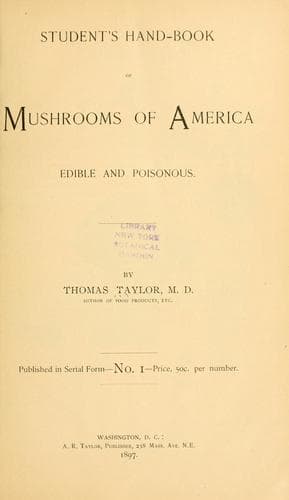
Student's Hand-book of Mushrooms of America, Edible and PoisonousTaylor, Thomas
Science
Student's Hand-book of Mushrooms of America, Edible and Poisonous
Taylor, Thomas
Mushrooms -- United States; Pathogenic fungi
To prepare for the table, very thin slices of young specimens should be
cut and either allowed to slowly simmer on the back of the range, or
soaked in milk and then fried in butter.
Of the genus Fistulina but one species, Fistulina hepatica, figured in
Plate X, is recorded as edible and indigenous to this country.
[Illustration: Plate X.
FISTULINA HEPATICA
1 Specimen, upper view. 2 Same, under view.
3 Specimen, upper view. 4 Same, under view.
5 Spores.
K. MAYO, del.]
PLATE X.
=Fistulina hepatica= Bull. "_Beefsteak Mushroom_," "_Liver Fungus_."
EDIBLE.
_Genus Fistulina_ Bull. Hymenophore fleshy, hymenium inferior, that is,
on the under surface of the cap, at first papillose; the papillae at
length elongated, and forming distinct tubes.
Besides Fistulina _hepatica_, five species of this genus are recorded in
Saccardo's Sylloge, viz., F. _radicata_ Schw., F. _spathulata_ B. & C.,
F. _pallida_ B. & R., F. _rosea_ Mont., and F. _antarctica_ Speg.; the
last indigenous to Patagonia.
F. _hepatica_ is the only species with which I am familiar. The plants
of this species are very irregular in form, rootless, epiphytal, often
stemless, and sometimes attached to the matrix by a very short stem.
This fungus is frequently found upon old oak, chestnut, and ash trees,
developing in the rotting bark. It appears first as a rosy pimple, or in
a series of red granules. In a very short time it becomes tongue-shaped,
sometimes kidney shaped, assuming the color of a beet root. As it
increases in size it changes form again, becoming broad in proportion to
its length, and changing in color to a deep blood red, and finally to a
dull liver tint. Its lower surface is often paler than its upper, it
being tinged with yellow and pinkish hues.
One author states that it requires about two weeks to attain its highest
development, after which it gradually decays.
It varies in size from a few inches to several feet in circumference.
Rev. M. J. Berkeley mentions one which weighed thirty pounds. It has
been styled, the "_poor man's fungus_," and in flavor resembles meat
more than any other.
The substance is fleshy and juicy in the early stage. The pileus is
papillose, the papillae elongated, and forming distinct tubes as the
pileus expands. These tubes are separable from each other, and with age
become approximate and jagged at their orifices. The tubes are at first
yellowish, with a pink tinge, becoming dingy with age. The fleshy
substance, or hymenophore, is often veined in light and dark red
streaks. The juice is pellucid, red, and slightly acid. Spores at first
nearly round, becoming elliptical, salmon color.
This fungus is esteemed in Europe, where it is eaten prepared in a
variety of ways.
Public-domain text, read in full here on John Shaqi.
Reviews
Reviews
No reviews yet
Be the first to share your thoughts on this work.
Elsewhere in the archive
Join the Discussion
Join the discussion
Sign in to leave a comment or review.
Sign InorCreate an account