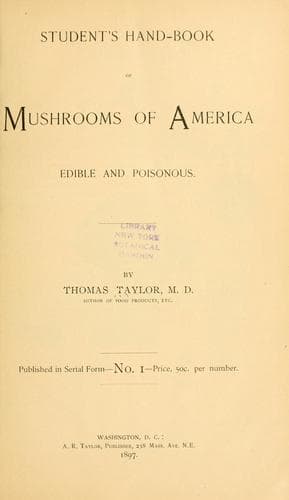
Student's Hand-book of Mushrooms of America, Edible and PoisonousTaylor, Thomas
Science
Student's Hand-book of Mushrooms of America, Edible and Poisonous
Taylor, Thomas
Mushrooms -- United States; Pathogenic fungi
The plants of the division Hypogaei or Hymenogastreae are subterranean in
habit, preferring a sandy soil. They are usually somewhat globose in
form, having a thick outer coat or peridium, though in some of the
genera the outer coat is very thin or obsolete. They are dingy in color.
In the young plants the interior substance somewhat resembles that of
the truffle, but is streaked and mottled. When old the gleba consists of
a dusty mass of threads and spores. They are known under various
appellations, such as "underground puff-balls," "false truffles," etc.
The Hypogaei are analogous to the Tuberacei, except that the spores are
not contained in asci as in the latter. Cooke says they appear to be the
link which unites the Basidiomycetes to the Ascomycetes by means of the
Tuberacei or genuine Truffles. In the young stage the basidia in the
Hypogaei are easily distinguished by the aid of the microscope.
In external features and habit of growth the species of Elaphomyces, a
genus of Tuberacei, closely resemble the Hypogaei, and in old age, when
the _asci_ have disappeared, it is difficult to distinguish the plants
of this genus from the Hypogaei.
The genus _Melanogaster_ contains an edible species, _M. variegatus_,
Tulasne, commonly known in Europe as the "Red Truffle" or "False
Truffle." _M. variegatus_ is usually gregarious and subterranean in
habit. The exterior is minutely granular, tawny yellow or reddish rust
color; the interior soft, bluish-black, streaked with yellow, the spore
mass in maturity becoming pubescent. The odor is pleasantly aromatic,
and the taste sweet. Under trees in woods. The variety _Broomeianus_
Berk. is paler in the marbling, which shows reddish instead of yellow
streaks. The pulpy mass is at first white, changing to a yellowish,
smoky hue.
LYCOPERDACEAE AND PHALLOIDEAE.
The plants figured in Plates G and H belong to the Lycoperdaceae and
Phalloideae.
LYCOPERDACEAE.
Massee, who has given the Puff-Ball group very close study, says that in
the gleba of the Lycoperdaceae, "at a very early period two sets of hyphae
are present. One, thin-walled, colorless, septate and rich in
protoplasm, gives origin to the trama, and elements of the hymenium, and
usually disappears entirely after the formation of the spores; the
second type consists of long thick-walled aseptate or sparsely septate,
often colored hyphae, which are persistent and form the capillitium. The
latter are branches of the hyphae forming the hymenium."
GENERA LYCOPERDON AND BOVISTA.
To the genera Lycoperdon and Bovista belong most of the "Puff-balls" and
all of the species figured in Plate G. In the plants of these two genera
the peridium is more or less distinctly double, and the hyphae, or
delicate threads which are seen mixed with the dusty mass of spores in
the mature plant, forming what is called the capillitium, are an
important element in classification.
Public-domain text, read in full here on John Shaqi.
Reviews
Reviews
No reviews yet
Be the first to share your thoughts on this work.
Elsewhere in the archive
Join the Discussion
Join the discussion
Sign in to leave a comment or review.
Sign InorCreate an account