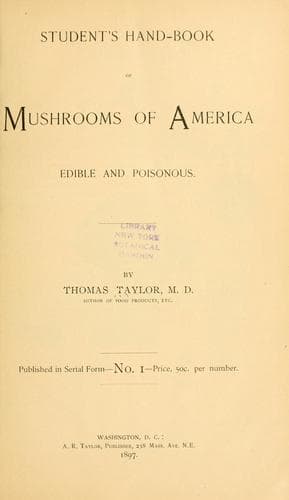
Student's Hand-book of Mushrooms of America, Edible and PoisonousTaylor, Thomas
Science
Student's Hand-book of Mushrooms of America, Edible and Poisonous
Taylor, Thomas
Mushrooms -- United States; Pathogenic fungi
Cortinarius _turmalis_, an edible autumnal species, having an ochraceous
or brownish-yellow cap with emarginate or decurrent gills, the latter at
first whitish, then reddish clay color, is found in abundance in some
parts of Maryland. The gills are never tinged with purple or blue. The
flesh is white. The plants are easily discovered by those familiar with
their habitat, as they grow under pine needles in groups, forming small
mounds extending over large spaces, and in these hiding places, in the
autumnal months, they are free from insects and dust. I have collected a
bushel of them in less than an hour in fresh condition in October. Some
of the French authors do not class this species as edible. Gillet, in
his Hymenomycetes of France, enumerates fifty-three edible species of
Cortinarius, but places _turmalis_ among the suspects. I find this
mushroom not only edible, but very valuable, because of its abundance in
the localities where found. It is often densely caespitose. The plant,
when mature, is from 3 to 5 inches high.
C. _sebaeceus_, found also in pine woods, is recorded as edible. The
plant is tall, white-stemmed, with broad tan-colored, somewhat viscid
cap; emarginate gills, clay color at first, at last cinnamon color; stem
solid, stout, fibrillose, and equal.
Cortinarius _collinitus_, Smeared Cortinarius, and Cortinarius
_cinnamomeus_, with its variety semi-sanguinea, have also been tested,
and found edible. The first of these is somewhat common. The plants when
fresh are covered with a glutinous substance, and this should be removed
before cooking. Cap smooth under the glutinous coat, light brown or
tawny yellow in color, flesh white; gills whitish or light gray when
young, cinnamon-hued in the matured plant. Stem solid, nearly equal,
cylindrical, yellowish, and somewhat scaly. C. _cinnamomeus_ belongs to
the division Dermocybe. The cap is thin at first, silky with innate
fibrids, becoming smooth, and varies from light brown to a dark cinnamon
color. The gills are yellowish, then cinnamon; stem downy or silky,
yellow. The variety _semi-sanguinea_ has the lamellae red, almost as in
the preceding species.
C. (Phlegmacium) _varius_, "Variable Cortinarius," edible, has a compact
fleshy viscid, even cap, brownish in color, gills at first violet,
changing to cinnamon, stout solid stem, white or whitish, adorned with
adpressed flocci, flesh white.
Public-domain text, read in full here on John Shaqi.
Reviews
Reviews
No reviews yet
Be the first to share your thoughts on this work.
Elsewhere in the archive
Join the Discussion
Join the discussion
Sign in to leave a comment or review.
Sign InorCreate an account