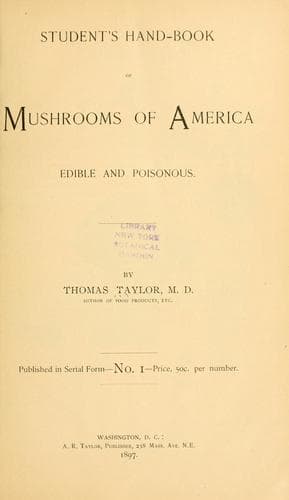
Student's Hand-book of Mushrooms of America, Edible and PoisonousTaylor, Thomas
Science
Student's Hand-book of Mushrooms of America, Edible and Poisonous
Taylor, Thomas
Mushrooms -- United States; Pathogenic fungi
Cap fleshy, somewhat tough, convex, then plane, smooth, even or slightly
cracked in places, umbo evanescent, reddish brown; gills adnexed, nearly
free, broad, distant, at length separating near the stem, firm, white,
changing to fawn color, or pale brown often spotted; stem long, stuffed,
then hollow, externally cartilaginous, contorted, swollen in the middle,
cracking in longitudinal slits, fusiform, tapering narrowly to a rooted
base, reddish brown. On stumps in woods in the autumn. Cap 1 to 2 inches
broad; stem 2 to 6 inches long. This species is densely caespitose. It is
very generally recorded among authors as edible, although the flesh is
somewhat tough. It requires long and slow cooking. An English author
recommends it for pickling. Only the caps should be used for this
purpose.
FIGS. 4 to 6.--=Ag. (Collybia) maculatus= A. & S. (=Collybia
maculata=). "_Spotted White Collybia_."
Cap fleshy and compact, convexo-plane, obtuse, smooth, even, margin
thin, at first involute, turned inwards, white; stem long and stout,
externally cartilaginous, ventricose, sometimes striate, tapering
towards the base; gills free, or nearly so, narrow, crowded, somewhat
linear, white, becoming spotted. Taste slightly acid. The whole plant is
creamy white, becoming spotted and stained throughout with rusty-brown
or foxy-red tints. The plants are usually large, long stemmed, and grow
in irregular clusters on decayed tree stumps in woods. Specimens of a
large size have been gathered in the fir woods near Mattapoisett,
Massachusetts. Cap 3 to 5 inches broad; stem 3 to 5 inches long. The
variety _immaculatus_ differs from the typical form in not becoming
spotted and in the broader gills, which are serrated.
FIGS. 7 to 9.--=Ag. (Collybia) velutipes= Curt. "_Velvet-Footed
Collybia_."
Cap fleshy, thin, at first convex, then plane, obtuse, smooth, viscid,
tawny or brownish yellow, turning dark; flesh yellowish and soft; gills
slightly adnexed, pale yellow; stem tough, stuffed, externally
cartilaginous, sometimes slender, but usually thick, covered with a
brown velvety down, dark bay color. This is a very common species in
some localities. It is densely caespitose, growing in heavy clusters on
old logs and tree trunks in parks, woods, and gardens. The plants are
quite gelatinous when cooked. Group figured from illustration by M. C.
Cooke.
Collybia _radicata_ Rehl. is recorded as an edible species. The plants
have a thin, slightly fleshy cap, slightly umbonate, wrinkled, and
glutinous at maturity; distant, white, adnexed gills, and tall, slender,
rigid stem. The latter is often twisted and usually attenuated upwards,
color pale brown. It has a long tapering root entering deeply into the
soil. This species is solitary in habit, and is commonly found in grass,
or near decayed stumps. Cap from 2 to 3 inches in diameter, stem 6
inches to 10 inches in length.
Public-domain text, read in full here on John Shaqi.
Reviews
Reviews
No reviews yet
Be the first to share your thoughts on this work.
Elsewhere in the archive
Join the Discussion
Join the discussion
Sign in to leave a comment or review.
Sign InorCreate an account