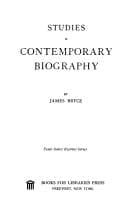
Studies in Contemporary BiographyBryce, James Bryce, Viscount
History
Studies in Contemporary Biography
Bryce, James Bryce, Viscount
Great Britain -- Biography
That revival within the Church of England which went on in various
forms from 1800 till 1870, at first Low Church or Evangelical in its
tendencies, latterly more conspicuously High Church and Ritualist,
began from below and worked upwards till at length it reached the
bishops. Lord Palmerston, influenced by Lord Shaftesbury, filled the
vacant sees that fell to him with earnest men, sometimes narrow,
sometimes deficient in learning, but often good preachers, and zealous
for the doctrines they held. When the High Churchmen found their way
to the Bench, as they did very largely under Lord Derby's and Mr.
Gladstone's rule, they showed as much theological zeal as the
Evangelicals, and perhaps more talent for administration. The popular
idea of what may be expected from a bishop rose, and the bishops rose
with the idea. As Bishop of Oxford, Dr. Samuel Wilberforce was among
the first to make himself powerfully felt through his diocese. His
example told upon other prelates, and prime ministers grew more
anxious to select energetic and popular men. So it came to pass that
the bishops began to be among the foremost men in the Church of
England. Some, like Dr. Magee of Peterborough, and afterwards of York,
were brilliant orators; some, like Dr. Lightfoot of Durham, profound
scholars; some, like Dr. Temple of Exeter, able and earnest
administrators. There remained but few who had not some good claim to
the dignity they enjoyed. So it may be said, when one compares the
later Victorian bishops with their Georgian predecessors, that no
class in the country has improved more. Few now sneer at them, for no
set of men take a more active and more creditable part in the public
business of the country. Their incomes, curtailed of late years in the
case of the richer sees, are no more than sufficient for the expenses
which fall upon them, and they work as hard as any other men for their
salaries. Though the larger sees have been divided, the reduction of
the toil of bishops thus effected has been less than the addition to
it due to the growth of population and the increased activity of the
clergy. The only defect which the censorious still impute to them is a
certain episcopal conventionality, a disposition to try to please
everybody by the use of vague professional language, a tendency to
think too much about the Church as a church establishment, and to
defer to clerical opinion when they ought to speak and act with an
independence born of their individual opinions. Some of them, as, for
instance, the three I have just mentioned, were not open to this
reproach. It was one of the merits and charms of Fraser that he was
absolutely free from any such tendency. Other men, such as Bishop
Lightfoot, have been not less eminent models of the virtues which
ought to characterise a great Christian pastor; but Fraser (appointed
some time before Lightfoot) was the first to be an absolutely
unconventional and, so to speak, unepiscopal bishop. His career marked
Public-domain text, read in full here on John Shaqi.
Reviews
Reviews
No reviews yet
Be the first to share your thoughts on this work.
Elsewhere in the archive
Join the Discussion
Join the discussion
Sign in to leave a comment or review.
Sign InorCreate an account