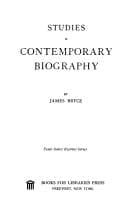
Studies in Contemporary BiographyBryce, James Bryce, Viscount
History
Studies in Contemporary Biography
Bryce, James Bryce, Viscount
Great Britain -- Biography
sketches of English towns, often wonderfully fresh and vigorous bits
of work. Anxiety to be scrupulously accurate runs into prolixity, and
Freeman so loved his subjects that it pained him to omit any
characteristic detail a chronicler had preserved; as he once observed
to a distinguished writer who was dealing with a much later period,
"You know so much about your people that you have to leave out a great
deal, I know so little that I must tell all I know." The tendency to
repeat the same word too frequently sprang from his preference for
words of Teutonic origin and his pride in what he deemed the purity of
his English. His pages would have been livelier had he felt free to
indulge in the humour with which his private letters sparkled; for he
was full of fun, though it often turned on points too recondite for
the public. But it was only in the notes to his histories, and seldom
even there, that he gave play to one of the merits that most commended
him to his friends.
So far of his books. He was, however, also Regius Professor of History
at Oxford during the last eight years of his life, and thus the head
of the historical faculty in his own university which he dearly loved.
That he was less effective as a teacher than as a writer may be partly
ascribed to his having come too late to a new kind of work, and one
which demands the freshness of youth; partly also to the cramping
conditions under which professors have to teach at Oxford, where
everything is governed by a system of examinations which Freeman was
never tired of denouncing as ruinous to study. His friends, however,
doubted whether the natural bent of his mind was towards oral
teaching. It was a peculiar mind, which ran in a deep channel of its
own, and could not easily, if the metaphor be permissible, be drawn
off to irrigate the adjoining fields. He was always better at putting
his own views in a clear and telling way than at laying his intellect
alongside of yours, apprehending your point of view, and setting
himself to meet it. Or, to put the same thing differently, you learned
more by listening to him than by conversing with him. He had not the
quick intellectual sympathy and effusion which feels its way to the
heart of an audience, and indeed derives inspiration from the sight of
an audience. In his election meetings I noticed that the temper and
sentiment of the listeners did not in the least affect him; what he
said was what he himself cared to say, not what he felt they would
wish to hear. So also in his lecturing he pleased himself, and chose
the topics he liked best rather than those which the examination
scheme prescribed to the students. Perhaps he was right, for he was of
those whose excellence in performance depends upon the enjoyment they
find in the exercise of their powers. But even on the topics he
selected, he did not take hold of and guide the mind of the students,
realising their particular difficulties and needs, but simply
Public-domain text, read in full here on John Shaqi.
Reviews
Reviews
No reviews yet
Be the first to share your thoughts on this work.
Elsewhere in the archive
Join the Discussion
Join the discussion
Sign in to leave a comment or review.
Sign InorCreate an account